Why A Red Light Bulb Is The Secret To Better Newborn Sleep
Hello, dear parent. If you’re reading this, chances are you’re tired. Not just ‘I could use a nap’ tired, but a deep, bone-weary exhaustion that only a new parent can truly understand. I see you. In my decades as a pediatric nurse and lactation consultant, I’ve sat with countless parents just like you, whispering in the quiet hours of the night, all asking the same question: ‘Will we ever sleep again?’
You’ve probably tried everything—swaddling, white noise, rocking, shushing—and you’re constantly searching for that one magic trick that will grant you a few precious, uninterrupted hours of sleep. What if I told you the secret isn’t a high-tech bassinet or a complicated sleep training method? What if it was as simple as changing a light bulb?
It sounds too good to be true, I know. But stick with me. We’re going to dive into the fascinating science behind your baby’s sleep and uncover why a simple red light bulb might just be the game-changer you’ve been desperately searching for. Let’s shed some light (the right kind, of course!) on how to create the perfect sleepy environment for your little one.
The Science of Sleep: Why Light Is a Big Deal for Your Little One
The Science of Sleep: Why Light Is a Big Deal for Your Little One
Before we talk about red light, we need to understand why light, in general, plays such a huge role in sleep. It all comes down to a tiny, powerful hormone called melatonin. You can think of melatonin as the ‘Dracula of hormones’—it comes out in the dark and signals to the body that it’s time to sleep.
Our bodies, even tiny newborn ones, have an internal 24-hour clock called the circadian rhythm. This internal clock is responsible for regulating our sleep-wake cycles. For adults, it’s pretty well established. For newborns, it’s a work in progress! Their internal clocks are not yet synced up with our day-and-night world. Our job is to gently guide them.
How Light Controls the Clock
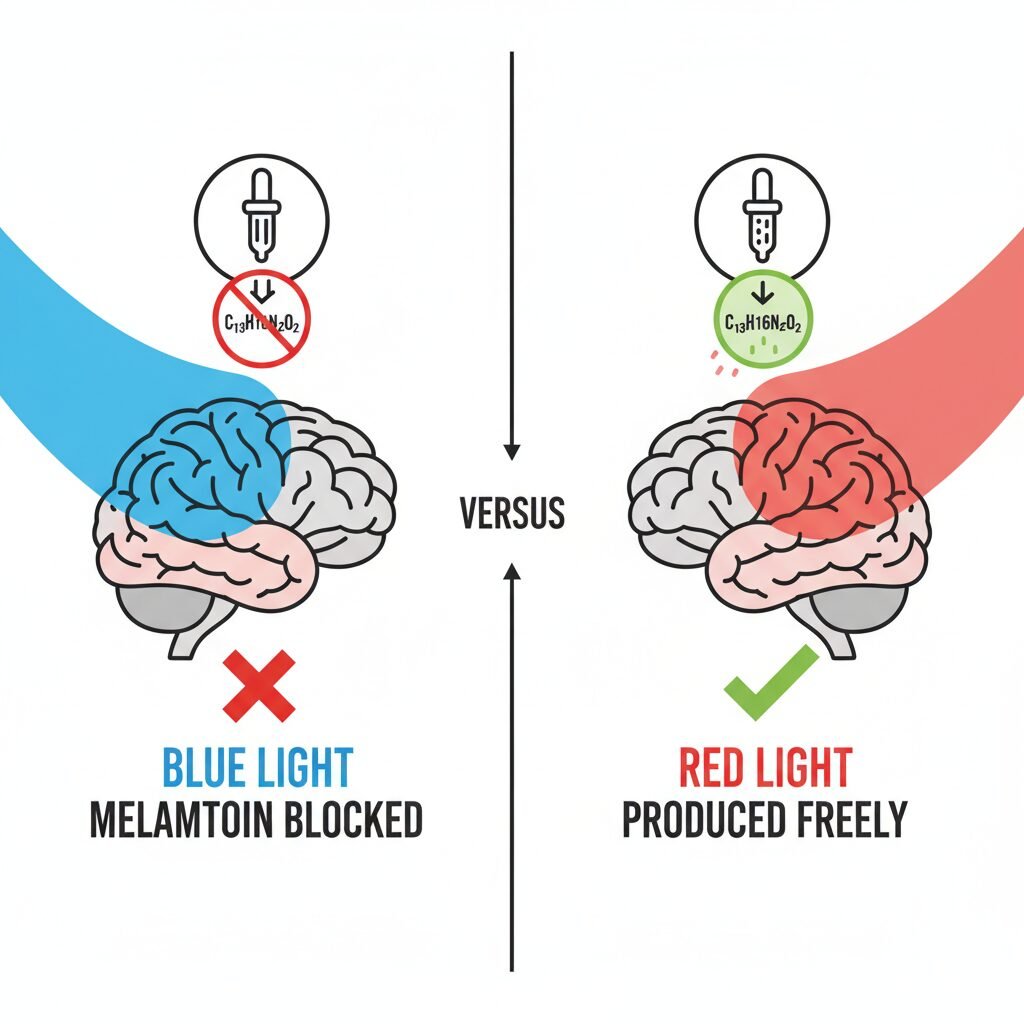
The primary cue for setting this internal clock is light. When light—especially blue light—hits our eyes, it sends a powerful ‘WAKE UP!’ signal to our brain. This signal travels to a part of the brain called the suprachiasmatic nucleus (a mouthful, I know!), which then tells the pineal gland to stop producing melatonin. This is fantastic during the day, as it helps us feel alert and awake.
But at night, it’s a different story. Here’s the problem for new parents:
- Standard Light Bulbs: The regular overhead light in the nursery, the lamp on your nightstand, and even many traditional night lights emit a lot of blue and white light.
- Screens, Screens, Everywhere: The light from your phone (which you’re likely scrolling during a 3 AM feeding), your tablet, and the TV are all packed with sleep-disrupting blue light.
When you flip on a normal lamp for a diaper change or check your phone, you’re inadvertently sending that ‘WAKE UP!’ signal to your baby’s brain. Their delicate, developing system stops making the sleepy-time hormone, and suddenly, they’re wide-eyed and ready to party. It also affects you, making it harder for you to fall back asleep after you’ve gotten the baby settled.
Think of it this way: Using a regular light at night is like drinking a tiny cup of coffee right before you want to go to bed. It just works against your goal of getting sleepy.
This is where the magic of red light comes in. It operates on a completely different part of the light spectrum and has a unique relationship with our brains.
Red Light to the Rescue: Your Secret Weapon for Night Wakings
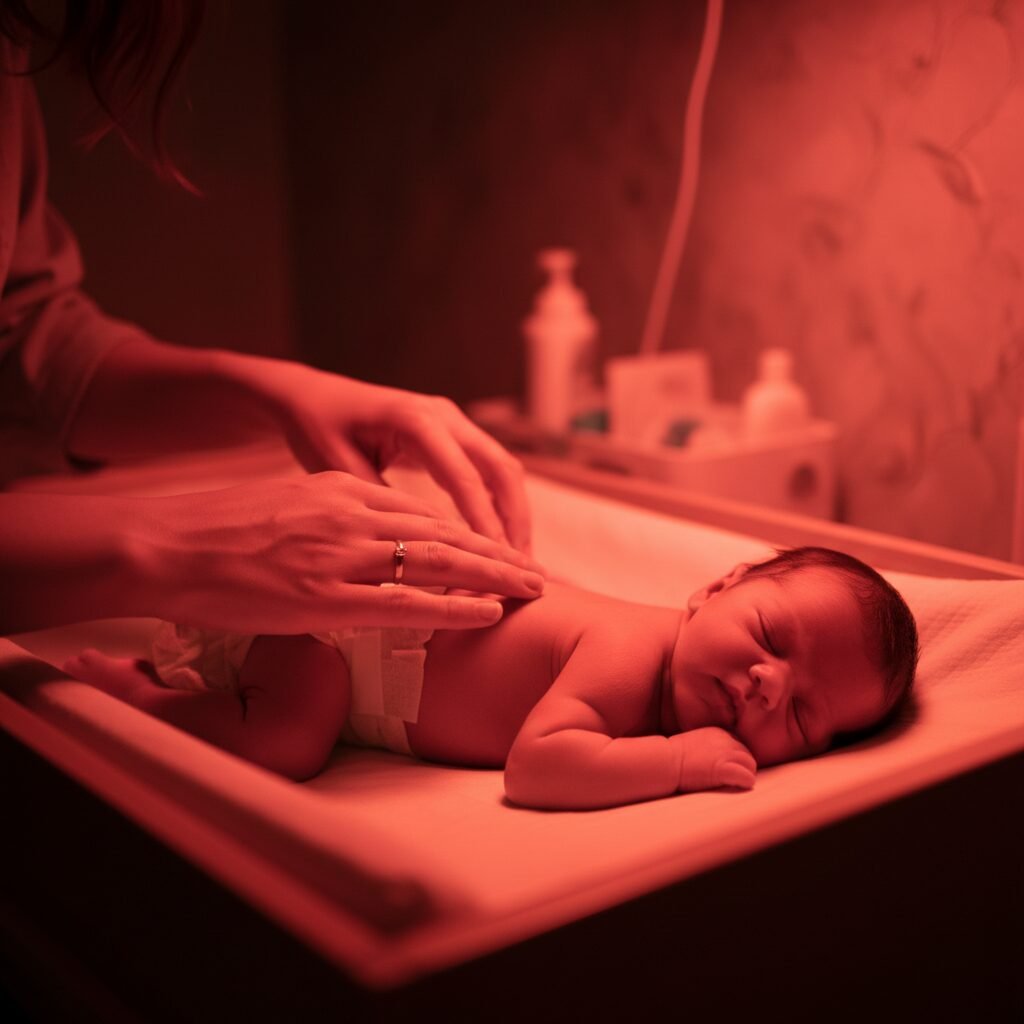
Red Light to the Rescue: Your Secret Weapon for Night Wakings
So, if blue and white light are the villains in our sleep story, red light is the gentle, unassuming hero. Why? Because red light has the longest wavelength of all visible colors. Due to its specific properties, research has shown that red light is the least likely color to suppress melatonin and disrupt our circadian rhythm.
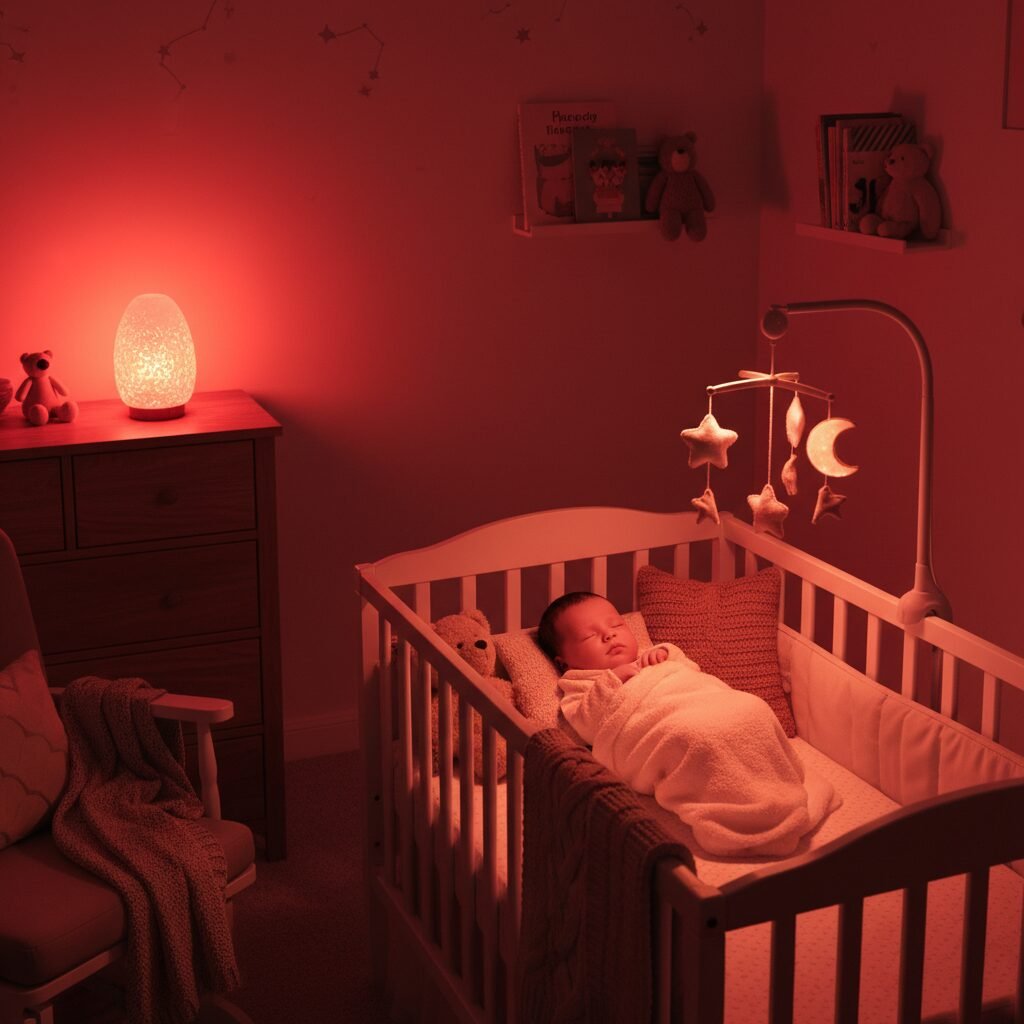
In simpler terms, your brain and your baby’s brain barely register red light as ‘daytime.’ This is a massive advantage for tired parents. It means you can have enough light to see what you’re doing—navigating the nursery, changing a diaper, finding a pacifier, or getting settled for a feeding—without jolting your baby (or yourself) into a state of full wakefulness.
The Key Benefits of a Red Light Nursery:
- Protects Melatonin Production: This is the big one. By using red light, you’re not interfering with that crucial flow of the ‘sleepy hormone.’ You’re keeping the ‘it’s nighttime’ signal strong and clear in your baby’s brain.
- Keeps Baby in a Drowsy State: Instead of a bright light making them wide awake and alert, the soft red glow keeps them in a calm, sleepy state. This makes it infinitely easier for them to drift back to sleep after a feeding or diaper change.
- Helps You Sleep Better: It’s not just for the baby! When you’re not exposed to bright light in the middle of the night, your own melatonin levels stay stable. You’ll find it much easier to fall back asleep once your head hits the pillow. No more lying awake, staring at the ceiling!
- Creates a Soothing, Womb-Like Environment: The warm, dim glow is thought to be comforting and reminiscent of the womb. It’s a gentle transition to the outside world, creating a peaceful atmosphere that promotes relaxation and security.
A Nurse’s Tip: Start using the red light about 30-60 minutes before you begin the bedtime routine. This helps to signal the wind-down period and gets the melatonin flowing even before your baby is in the crib.
By making this one simple switch, you’re not just changing a bulb; you’re fundamentally changing the nighttime environment. You’re transforming it from a place of potential disruption into a consistent, sleep-supportive sanctuary.
Putting It Into Practice: Your Simple Guide to Using Red Light
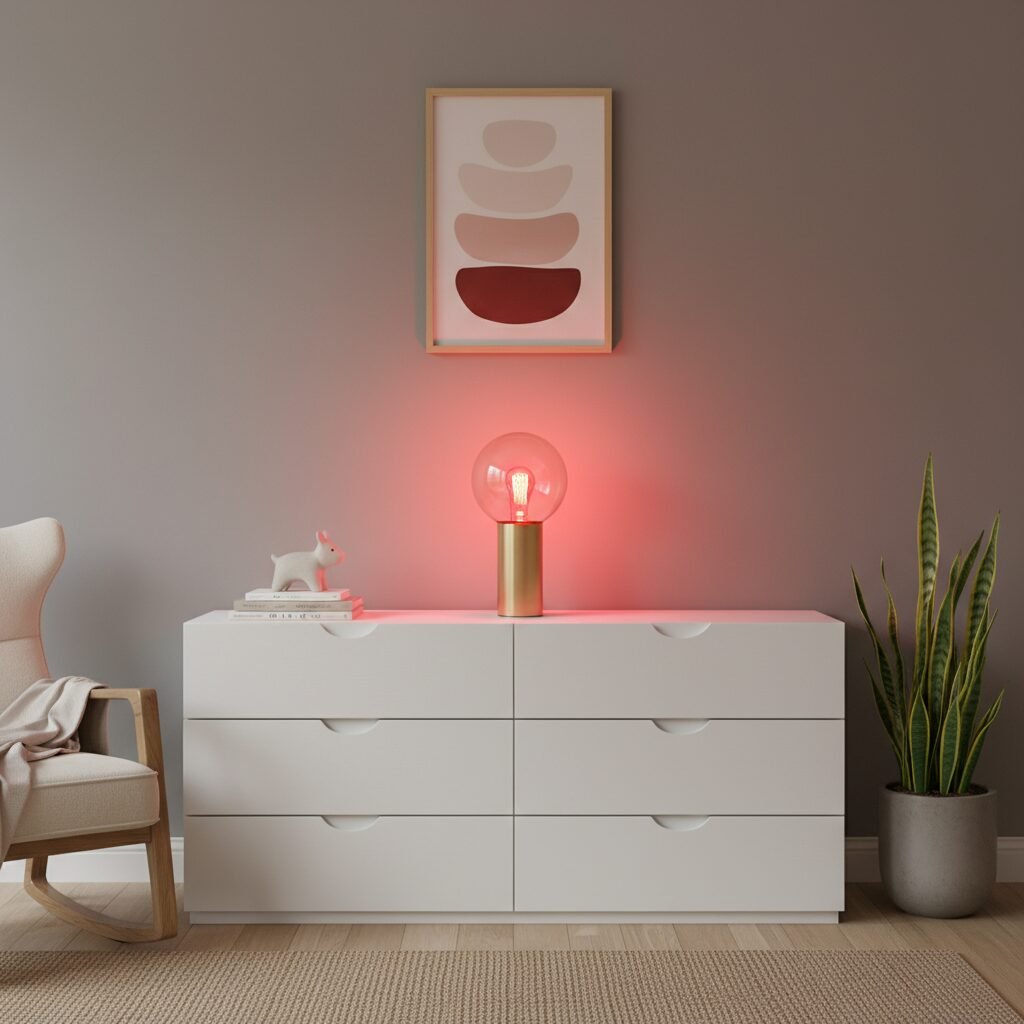
Putting It Into Practice: Your Simple Guide to Using Red Light
Okay, you’re convinced. You’re ready to embrace the red light revolution! But where do you start? Don’t worry, it’s incredibly simple. Here’s your step-by-step guide to setting up the perfect, sleep-friendly nursery.
Step 1: Choose the Right Red Light
Not all red lights are created equal. You’re not looking for a party light or a heat lamp. You need something specifically designed for sleep and ambiance. Here are your options:
| Light Type | Pros | Cons | Best For |
|---|---|---|---|
| Red LED Light Bulb | Inexpensive; Fits in any standard lamp; Low energy use; Doesn’t get hot. | You need to have a spare lamp base. | Parents on a budget who already have a lamp they can use. |
| Dedicated Red Night Light | Designed for nurseries; Often has a dimmer function; Plug-and-play simple. | Can be more expensive than a simple bulb. | Parents who want a dedicated, aesthetically pleasing solution. |
| ‘Smart’ Bulb | Can change to any color; Can be controlled with your phone and dimmed. | Most expensive option; Can be complicated to set up. | Tech-savvy parents who want versatility. |
Whichever you choose, look for a true red light. Some ‘color-changing’ bulbs produce a pinkish or orangey light that may still contain some blue light wavelengths. Stick to a dedicated red for the best results.
Step 2: Perfect Placement
Where you put the light matters. You want to create a gentle, ambient glow, not a spotlight.
- Avoid Direct Sightlines: Never place the light directly over the crib or in your baby’s direct line of sight.
- Use a Lampshade: If you’re using a bulb in a lamp, a lampshade is a must. It will diffuse the light, making it softer and more evenly distributed.
- Bounce the Light: A great trick is to position the lamp so it points towards a wall. The light will bounce off the wall and fill the room with a very soft, indirect glow.
- The Floor is Your Friend: Placing a small lamp on the floor in a corner is another fantastic way to provide enough light to see without it being intrusive.
Step 3: Timing is Everything
To get the most benefit, use your red light consistently.
- The Wind-Down Hour: Turn on only the red light about an hour before bedtime. Turn off all other overhead lights and screens. This starts the melatonin production process early.
- Bedtime Routine: Conduct your entire bedtime routine—changing into pajamas, reading a story, the final feeding—under the calming red glow.
- All Night Long: Leave the red light on all night. This way, when you enter the room for a night waking, you won’t need to fumble for a switch and risk turning on a bright, disruptive light.
- No Cheating! The most important rule is to commit. Don’t turn on the hallway light. Don’t check your phone in the nursery (the blue light from your screen will undo all your hard work!). If you need your phone, make sure its screen is set to the dimmest, warmest setting possible.
Answering Your Top Questions: Red Light FAQs for Tired Parents

Answering Your Top Questions: Red Light FAQs for Tired Parents
It’s totally normal to have questions when trying something new for your baby. As a nurse, I love questions! It means you’re being thoughtful and careful. Let’s tackle some of the most common ones I hear about using red light.
1. Is red light safe for my newborn’s eyes?
Absolutely, yes. This is a very important question. The type of low-wattage, ambient red light we’re talking about for a nursery is completely safe. It’s far less harsh and intense than the bright white and blue lights we expose ourselves to every day. Think of the gentle glow of a sunset—it’s a similar wavelength. We are not talking about high-intensity red light therapy devices, but simple, low-power LED bulbs or night lights.
2. Will my baby become dependent on the red light to sleep?
This is a common worry, but you can rest easy. Think of the red light less as a ‘sleep crutch’ and more as a powerful ‘sleep cue.’ Just like a warm bath, a familiar story, or a special swaddle, the red light becomes part of the bedtime routine. It’s a strong environmental signal to your baby’s brain that says, ‘It’s time to rest now.’ As your child gets older and their circadian rhythm fully matures, you can easily wean them off it if you choose, or they can keep it as a comforting night light.
3. What about other colors? I have a salt lamp that’s orange. Is that okay?
While a Himalayan salt lamp provides a lovely, warm glow, it’s not the same as a true red light. Orange and yellow light have shorter wavelengths than red light and are more likely to have some impact on melatonin suppression, though they are still much better than white or blue light. For the maximum sleep-protecting benefit, pure red is scientifically the best choice.
4. How long will it take to see a difference in my baby’s sleep?
This is the million-dollar question! Every baby is different. Some parents report an immediate improvement in how easily their baby falls back to sleep during night wakings within the first couple of nights. For others, it might be a more gradual process over a week or two as their baby’s body adjusts to the new, consistent light cues. The key is consistency. Stick with it every single night to give it the best chance of working.
5. Can I just use a regular bulb and put a red scarf over it?
Safety Warning: Please, please do not do this. Draping any fabric over a light bulb, even a low-wattage one, is a serious fire hazard.
It’s much safer to invest a few dollars in a proper red LED bulb. LEDs produce very little heat, are energy-efficient, and are designed to be used safely in lamps.
Conclusion
You’ve Got This, and You Deserve to Sleep
Navigating the world of newborn sleep can feel like an overwhelming journey in the dark. But sometimes, the most effective solutions are the simplest ones. Swapping out a light bulb isn’t a magic wand that guarantees your baby will sleep through the night tomorrow, but it is a powerful, science-backed tool that can make a real difference.
It works with your baby’s natural biology, not against it. It helps you create a calm, consistent, and peaceful environment that supports rest for both of you. During those quiet, middle-of-the-night moments, that soft red glow will be a gentle reminder that you are doing everything you can to care for your little one.
So, be patient with your baby, and most importantly, be patient and kind to yourself. You are learning, growing, and doing an incredible job. Now, go change that light bulb. A better night’s sleep might be closer than you think.