

Soothe the Scream: Best Gentle Formulas for Sensitive Tummies
Hey there, new parent. Let’s talk. I know that sound—the high-pitched, inconsolable cry that seems to echo right in your soul. You’ve checked the diaper, offered a pacifier, swaddled them up tight, and you’re still faced with a fussy, uncomfortable little one. When the fussiness seems to center around feeding time, it’s easy to feel overwhelmed and wonder, ‘Am I doing something wrong?’
Please, take a deep breath and hear me when I say: You are doing an amazing job. Tummy troubles are incredibly common in new babies. Their digestive systems are brand new and still figuring things out. For many, this can lead to gas, spit-up, and general discomfort that can make feeding time stressful for everyone involved. The good news is that you have options, and sometimes, a simple change in formula can make a world of difference. As a pediatric nurse and lactation consultant, I’ve sat with countless parents just like you, helping them navigate the confusing world of baby formulas. This guide is like having me right there with you, holding your hand as we figure this out together. We’ll decode your baby’s cues, break down the science behind ‘gentle’ formulas, and find a path toward happier, more peaceful feedings.
Decoding Your Baby’s Discomfort: Is It a Sensitive Tummy?

Before we march down the formula aisle, let’s play detective. How can you tell if it’s a true tummy sensitivity versus the normal fussiness of being a brand new human? While every baby is different, there are some common clues that point toward digestive discomfort. Think of this as a gentle checklist, not a diagnosis. If you’re nodding along to several of these, a sensitive formula might be worth discussing with your pediatrician.
Common Signs of a Sensitive Stomach:
- Excessive Gas: We’re not talking about a few cute toots. This is the kind of gas that seems painful. You might notice your baby grunting, straining, and pulling their little legs up to their chest.
- Frequent Spit-Up: All babies spit up, but if it seems like a large portion of every feed is coming back up, or if the spit-up is forceful (projectile), it’s a sign their tummy is struggling.
- Extreme Fussiness After Feedings: A little fussing can be normal as milk settles. But if feedings are consistently followed by long periods of crying and obvious discomfort, their formula could be the culprit.
- Constipation or Diarrhea: Your baby’s poop is a window into their digestive health! Stools that are hard, pebble-like, and infrequent (constipation) or very watery and frequent (diarrhea) are red flags. A typical formula-fed baby’s stool should be a peanut butter-like consistency.
- An Arching Back During or After Feeds: This is a classic sign of discomfort, often related to reflux, where stomach contents come back up.
- Trouble Sleeping: If tummy pain is keeping your little one (and you!) up at night, it’s a clear sign something needs to be addressed.
Remember, you know your baby best. If your gut tells you something is off, trust that instinct. These symptoms are your baby’s only way of communicating that they’re uncomfortable.
Navigating the Formula Aisle: What Makes a Formula ‘Gentle’?
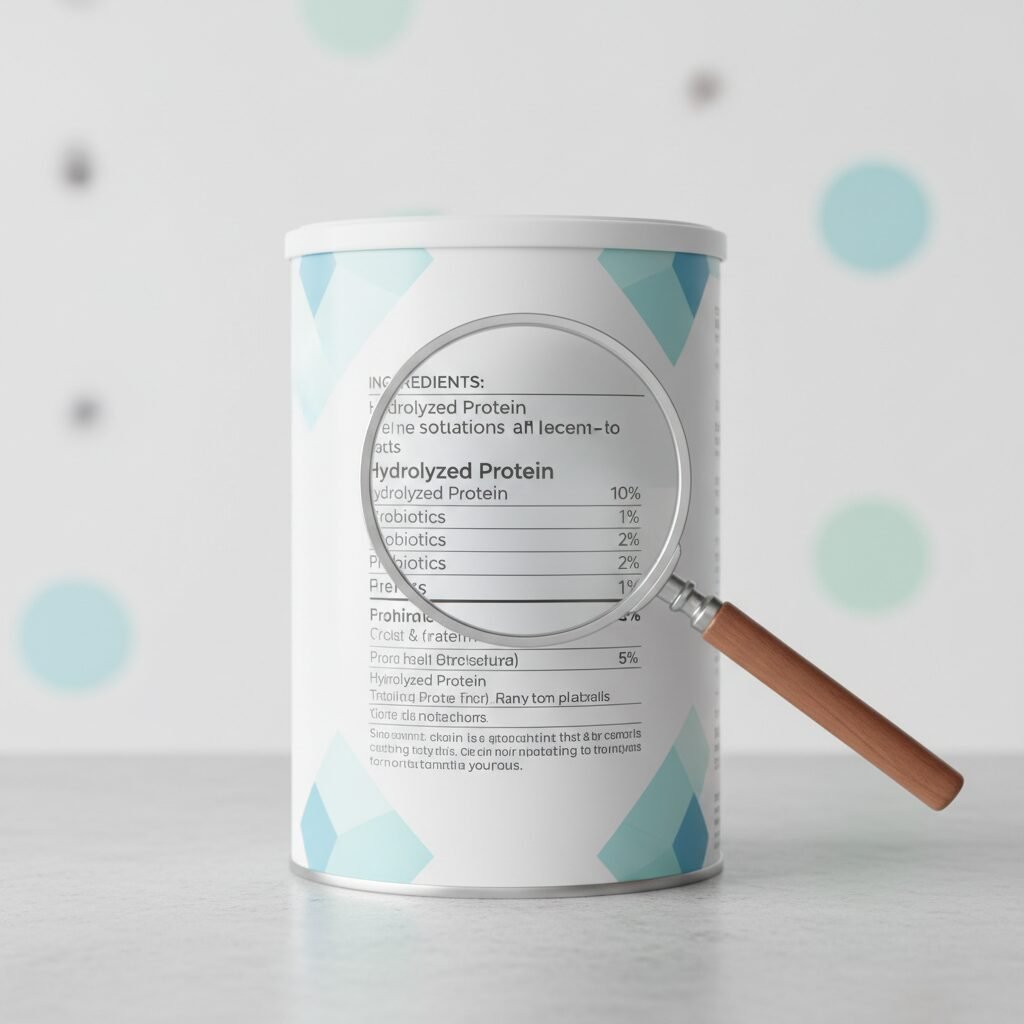
Walking into the formula aisle can feel like entering a science lab. The labels are covered in complex terms, and every can promises to be the best. So, what are we actually looking for? What magic ingredients make a formula ‘gentle’ or ‘sensitive’?
It’s not magic, it’s science! These special formulas are designed to be easier for a baby’s immature digestive system to break down and absorb. Here’s what sets them apart:
- Broken-Down Proteins (Hydrolyzed Proteins): Standard formulas use whole cow’s milk proteins, which can be large and tough for some babies to digest. Gentle formulas often use partially hydrolyzed proteins. Imagine a long pearl necklace (the whole protein) being snipped into smaller, more manageable pieces. This pre-digestion process makes the protein easier on the tummy.
- Reduced Lactose: Lactose is the natural sugar in milk. While true lactose intolerance is rare in infants, many have a temporary difficulty digesting it. Sensitive formulas often have significantly reduced lactose levels, replacing it with other carbohydrates like corn syrup solids, which can ease gas and fussiness.
- Probiotics and Prebiotics: Just like in adults, a healthy gut is full of good bacteria. Probiotics are live, beneficial bacteria, while prebiotics are a type of fiber that feeds those good bacteria. Many gentle formulas include these to help support a healthy gut microbiome, which can improve digestion and overall comfort.
- No Palm Olein Oil: Some studies have suggested that the fat blend in formula can affect stool consistency. Some brands create ‘no palm olein oil’ blends, which they state can help produce softer stools, more like those of a breastfed baby, reducing the chances of constipation.
Understanding these key components helps you move beyond the marketing and become an informed consumer. You’re no longer just grabbing a can; you’re choosing specific ingredients to help your baby feel better.
A Closer Look: Comparing Types of Gentle Formulas

Okay, you understand the science, now let’s talk application. The term ‘gentle’ is a broad category. To find the right fit, you need to know the specific sub-types and what they’re designed to do. Think of it as different levels of support for your baby’s tummy.
Here’s a breakdown of the most common categories you’ll find, from standard ‘sensitive’ options to more specialized formulas for true allergies. This table can be a great tool to take with you to your pediatrician to discuss options.
| Formula Type | Key Feature | Best For Babies Who… |
|---|---|---|
| Sensitive / Gentle | Partially hydrolyzed (broken down) milk proteins and/or reduced lactose. | Are generally fussy, gassy, or crying after feedings. This is often the best first step for mild tummy troubles. |
| Lactose-Reduced / Lactose-Free | Contains very little or no lactose (milk sugar). | Have suspected lactose sensitivity. This is less common than protein sensitivity but can be a source of significant gas and diarrhea. |
| Soy-Based | Uses soy protein instead of cow’s milk protein. Is naturally lactose-free. | Have a hereditary lactose intolerance or galactosemia. The AAP recommends trying a hydrolyzed formula first for general fussiness before jumping to soy. |
| Hypoallergenic (Extensively Hydrolyzed) | Cow’s milk proteins are broken down into very small pieces. | Have a confirmed cow’s milk protein allergy (CMPA). Symptoms can include hives, eczema, vomiting, or blood in the stool. Must be recommended by a doctor. |
| Hypoallergenic (Amino Acid-Based) | Proteins are in their simplest form (free amino acids). No milk protein chains at all. | Have a severe cow’s milk protein allergy or multiple food allergies and did not respond to extensively hydrolyzed formula. This is a prescription-level solution. |
Safety First! Never switch to a specialized hypoallergenic formula without explicit guidance from your pediatrician. They can properly diagnose an allergy and ensure your baby is getting the right nutrition for their specific needs.
The Switch-Up: How to Safely Transition to a New Formula

You’ve consulted your pediatrician and picked a new formula. Hooray! But hold on—don’t just swap one for the other overnight. A sudden change can be a shock to that sensitive little tummy we’re trying so hard to soothe. A slow, gradual transition is the key to success.
Think of it like easing into a warm bath, not jumping into a cold pool. This method gives your baby’s digestive system time to adjust. The process usually takes about a week.
A Step-by-Step Transition Plan:
- Days 1-2: The Introduction. Start by mixing 75% of the old formula with 25% of the new formula in every bottle. For a 4-ounce bottle, this would be 3 ounces of the old formula and 1 ounce of the new. Watch your baby closely for any changes in fussiness, gas, or stools.
- Days 3-4: The Halfway Point. If things are going well, move to a 50/50 mix. For a 4-ounce bottle, that’s 2 ounces of old and 2 ounces of new. You’re giving their system more of the new formula to get used to.
- Days 5-6: Almost There. Now, tip the scales. Mix 25% of the old formula with 75% of the new formula. So, for a 4-ounce bottle, it’s 1 ounce old and 3 ounces new. By this point, your baby’s tummy is well-acquainted with the new ingredients.
- Day 7 and Beyond: Full Transition. Your baby is now ready for 100% of the new formula. Congratulations, you did it!
It’s important to give any new formula a solid one to two weeks to see if it’s truly making a difference. It can take time for their system to fully regulate and for the benefits (less gas, less spit-up, more smiles!) to become clear.
Beyond the Bottle: Other Ways to Soothe a Sensitive Tummy

While changing formulas can be a game-changer, it’s often not the only piece of the puzzle. Supporting your baby’s digestion involves more than just what’s in their bottle. These simple, gentle techniques can work in tandem with their new formula to bring even more relief.
- Paced Bottle Feeding: This technique mimics the flow of breastfeeding and prevents a baby from gulping too much air. Hold the bottle horizontally to the floor, and let your baby draw the milk out, taking frequent breaks.
- Burp Like a Pro: Don’t wait until the end of the feed to burp. Try burping after every ounce or two. This prevents large air bubbles from getting trapped in their stomach. Experiment with different positions: over the shoulder, sitting up on your lap, or lying face-down across your knees.
- The ‘I Love U’ Tummy Massage: When your baby is calm (not in the middle of a crying fit), a gentle tummy massage can help move gas along. With a little baby-safe lotion on your hands, trace the letter ‘I’ down their left side, an ‘L’ across and down, and an upside-down ‘U’ from right to left.
- Bicycle Legs: Lay your baby on their back and gently move their legs in a bicycling motion. This movement can help relieve pressure and pass gas.
- Consider Probiotic Drops: Even if their new formula has probiotics, you can talk to your pediatrician about adding a dedicated infant probiotic drop, like those containing Lactobacillus reuteri, which has been studied for its effectiveness in reducing colic.
- A Warm Bath: Never underestimate the power of warm water. A soothing bath can relax your baby’s abdominal muscles and provide overall comfort.
Combining these gentle practices with the right formula creates a holistic approach to tackling tummy troubles, empowering you with more tools to comfort your baby.
When to Call the Pediatrician

As a new parent, it can be hard to know what’s ‘normal’ and what warrants a call to the doctor. While most fussiness and gas are developmental, there are certain red flags that indicate a more serious issue that goes beyond a simple formula switch. Your pediatrician is your partner in this journey, and they want to hear from you if you’re concerned.
Do not hesitate to call your doctor’s office if you notice any of the following:
- Projectile vomiting (forceful, not just a dribble of spit-up).
- Blood or mucus in your baby’s stool.
- A rash, hives, or other signs of an allergic reaction.
- Failure to gain weight or weight loss.
- Extreme lethargy or being unusually difficult to wake.
- A fever along with any digestive symptoms.
- Crying that is truly inconsolable for hours on end.
These can be signs of a true medical condition like a severe milk protein allergy, pyloric stenosis, or a gastrointestinal illness. Trying to manage these at home can be dangerous. It’s always, always better to be safe and make the call. No question is a silly question when it comes to your baby’s health.
Conclusion
Navigating the first few months with a new baby is a journey of love, learning, and a whole lot of trial and error. If you’re dealing with a sensitive tummy, remember to be patient—both with your baby and with yourself. Finding the right formula and routine can take a little time, but you will get there. Each fussy period, each gassy wiggle, is a piece of information that helps you understand your baby’s unique needs better.
Trust your instincts, lean on your pediatrician for guidance, and don’t be afraid to try some of the soothing techniques we’ve talked about. You are your baby’s expert and their safe place. By addressing their discomfort with love and informed choices, you’re not just soothing their tummy; you’re building a foundation of trust and security. You’ve got this, and soon enough, those frantic cries will be replaced by happy gurgles and peaceful, milk-drunk smiles.