

On-Demand vs. Scheduled Feeding: Which Method Gets You More Sleep?
Welcome to parenthood, where your heart is fuller and your coffee cup is emptier than you ever imagined. If there’s one question that echoes in the quiet (and not-so-quiet) hours of the night, it’s this: How can I get more sleep? It’s a question that often leads you straight to the great baby-feeding debate: Should you feed your little one whenever they seem hungry (on-demand), or should you establish a predictable routine (a schedule)?
As a pediatric nurse and lactation consultant who has sat with countless exhausted, loving parents just like you, I want to reassure you of one thing: you are not alone. The desire for a full night’s sleep is not selfish; it’s a biological need. The good news is that we can navigate this topic together, without judgment, and find an approach that nourishes your baby and preserves your sanity. Let’s break down both methods, weigh the pros and cons, and finally answer that million-dollar question about which path might lead to more precious shut-eye.
What is On-Demand Feeding? The ‘Listen to Your Baby’ Approach

What is On-Demand Feeding? The ‘Listen to Your Baby’ Approach
On-demand feeding, also known as responsive feeding or baby-led feeding, is exactly what it sounds like: you feed your baby whenever they show signs of hunger. Instead of watching the clock, you watch your baby. This is the method recommended by the American Academy of Pediatrics (AAP) and most lactation experts, especially for newborns.
Recognizing Early Hunger Cues
The key to successful on-demand feeding is learning your baby’s unique language. Crying is actually a late sign of hunger. By the time they’re wailing, they can be frantic, making it harder to latch and settle. Look for these earlier, more subtle cues:
- Rooting: Turning their head and opening their mouth as if searching for the nipple.
- Lip Smacking or Licking: Making little sucking motions with their mouth.
- Bringing Hands to Mouth: Sucking on their fists or fingers.
- Increased Alertness or Activity: Waking up and looking around, or moving their arms and legs more actively.
For breastfed babies, this method is crucial. Your milk supply works on a ‘supply and demand’ basis. The more your baby nurses, the more your body is signaled to produce milk. Frequent nursing in the early weeks establishes a robust milk supply for the months ahead. Newborns have tiny stomachs (about the size of a cherry on day one!) and they digest breast milk quickly, so it’s normal for them to need to eat every 1.5 to 3 hours.
A Gentle Reminder: In the first month, it’s common for breastfed babies to eat 8-12 times (or more!) in a 24-hour period. It can feel like you’re constantly feeding, but this is normal and essential for their growth and your milk supply.
What is Scheduled Feeding? The ‘Predictability’ Approach

What is Scheduled Feeding? The ‘Predictability’ Approach
Scheduled feeding involves feeding your baby at set intervals, for example, every three hours. The goal is to create a predictable routine for both you and your baby. Parents who lean towards this method often find that the structure helps them plan their day, which can be a lifeline amidst the beautiful chaos of new parenthood.
A typical parent-led schedule might involve waking the baby to eat every 3 hours during the day and perhaps allowing for a slightly longer stretch at night, assuming the baby is gaining weight well. This approach is often more common with formula-fed babies, as formula takes a bit longer to digest than breast milk.
Is a Schedule Ever Okay for a Newborn?
While strict, clock-based feeding is generally discouraged for young newborns, the concept of a ‘routine’ isn’t inherently bad. The danger lies in ignoring your baby’s clear hunger cues because ‘it’s not time yet.’ A hungry baby is a stressed baby. However, as your baby gets a little older (past the initial newborn stage, around 2-3 months), their patterns will naturally become more predictable. At that point, you might find a gentle, flexible schedule works well.
Important Safety Note: Never let a newborn go more than 4 hours without feeding, even overnight, until your pediatrician gives you the green light. Young babies, especially those with jaundice or who were premature, can be overly sleepy and may not wake up to signal hunger, putting them at risk for dehydration and poor weight gain.
The appeal of a schedule is undeniable. Knowing you have a three-hour window can feel like a gift. But it’s vital that any schedule is baby-led and flexible, rather than rigid and parent-imposed, particularly in the beginning.
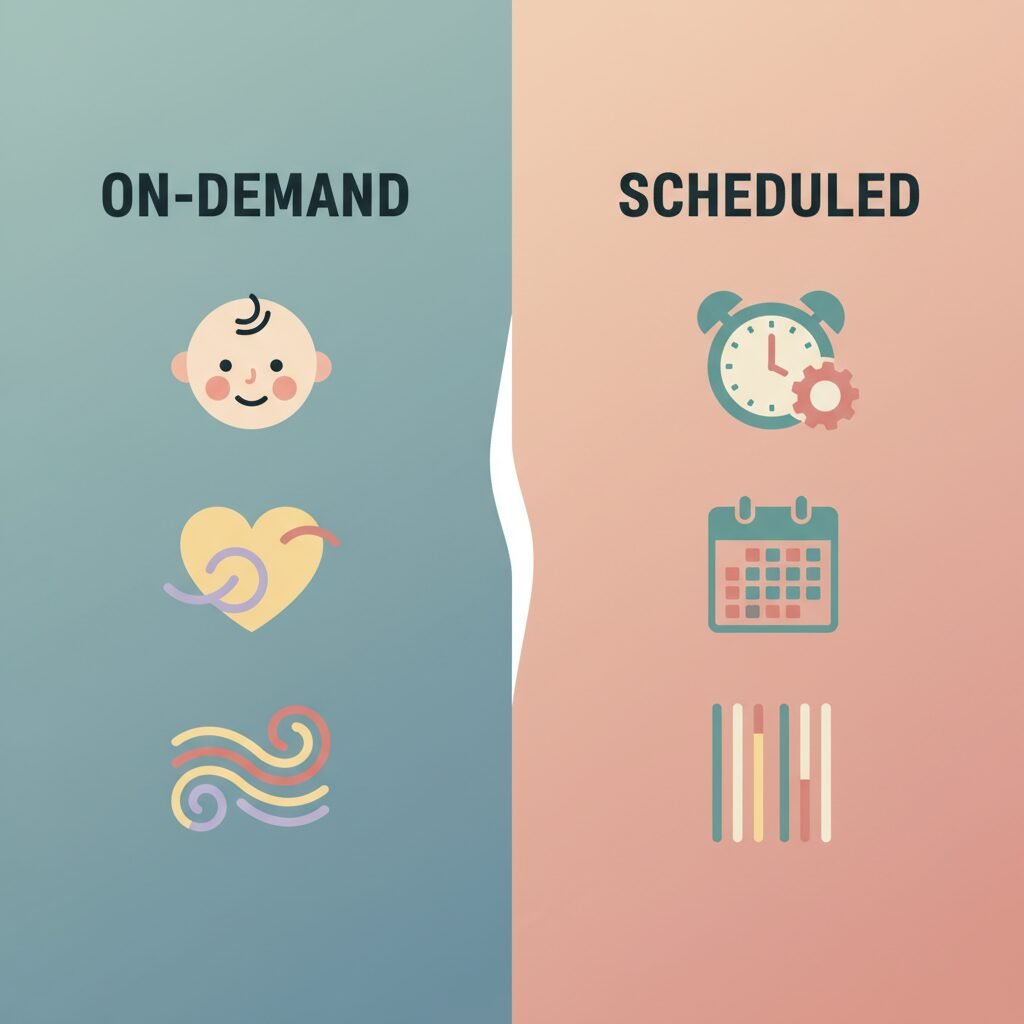
The Big Comparison: On-Demand vs. Scheduled Feeding Head-to-Head
The Big Comparison: On-Demand vs. Scheduled Feeding Head-to-Head
So, how do these two philosophies stack up when you put them side-by-side? It’s not about one being ‘good’ and the other ‘bad.’ It’s about understanding their different impacts on you and your baby. Let’s break it down.
| Feature | On-Demand Feeding (Baby-Led) | Scheduled Feeding (Parent-Led) |
|---|---|---|
| Responsiveness to Baby | Excellent. This method honors the baby’s biological hunger and comfort needs in real-time. It builds trust and a strong attachment, as the baby learns their needs will be met promptly. | Can be problematic. A strict schedule may require parents to ignore hunger cues or wake a sleeping baby who isn’t ready to eat, potentially overriding the baby’s natural instincts. |
| Breastfeeding & Milk Supply | Optimal. Frequent and effective nursing directly stimulates milk production, helping to establish and maintain a robust supply that’s perfectly calibrated to the baby’s needs. | Risky, especially in the early weeks. Restricting nursing sessions can signal your body to produce less milk, potentially leading to low supply issues. It requires very careful management if breastfeeding. |
| Predictability for Parents | Low, especially at first. The unpredictable nature can feel chaotic and make it difficult to plan outings or even a shower. It requires surrendering to the baby’s rhythm. | High. The structure is the main appeal. It helps parents anticipate the baby’s needs and structure their own day, which can reduce anxiety for some. |
| Parental Sleep | Initially, it may lead to more frequent night wakings as you respond to every cue. However, it ensures the baby gets all the calories they need, which can lead to longer sleep stretches sooner as they grow. | The goal is to create longer sleep stretches sooner, but this isn’t guaranteed. If a baby is put to bed hungry because it’s not ‘feeding time,’ they won’t sleep well anyway. |
| Best For… | All newborns, and it is considered the gold standard for breastfed babies of any age. It’s ideal for parents who are comfortable with flexibility and following their baby’s lead. | May be considered for formula-fed babies or older infants (with pediatrician’s approval) who are thriving and gaining weight well. It can be helpful for parents who need more structure for their own mental well-being. |
So, Which Method *Actually* Gets You More Sleep?

So, Which Method *Actually* Gets You More Sleep?
This is the question that brought you here, and I’m going to give you the honest, nurse-and-mom-approved answer: In the newborn phase, on-demand feeding is the safest and most effective path, and it will likely lead to better sleep for everyone in the long run.
I know, that might not be what you wanted to hear. You were probably hoping I’d reveal a secret schedule that guarantees an eight-hour stretch. But here’s the reality: a newborn’s sleep is not dictated by a clock. It’s dictated by their stomach size, their developmental needs, and their need for comfort. Forcing a schedule on a tiny baby who is biologically wired to eat frequently often backfires, leading to a frustrated, overly hungry baby who sleeps in short, fitful bursts.
The Short-Term vs. Long-Term View
In the short-term (the first 6-8 weeks), yes, feeding on demand will probably mean you are waking up more often. You might be up every two hours. It’s exhausting, but you are meeting your baby’s every need. You’re filling their tummy, building your milk supply, and comforting them with your presence. This is an investment.
By ‘tanking them up’ and responding to their needs consistently, you help them grow strong and healthy. A baby who is gaining weight well and feels secure is a baby who will, eventually, be developmentally capable of linking their sleep cycles and giving you those longer stretches you’re dreaming of. In a way, on-demand feeding helps your baby ‘graduate’ to a more predictable pattern naturally, when they are ready.
Trying to force a schedule too early can lead to issues with weight gain and milk supply, which creates more stress and often leads to *less* sleep for everyone involved. The most rested families I’ve worked with are the ones who surrendered to the chaos of the fourth trimester and focused on following their baby’s lead.
A Hybrid Approach: Finding Your Family’s Perfect Rhythm

A Hybrid Approach: Finding Your Family’s Perfect Rhythm
Life is rarely black and white, and baby feeding is no exception. As your baby grows and you move out of the intense newborn phase (usually around 2-4 months), you don’t have to be a strict devotee to one camp. You can absolutely create a rhythm that blends the best of both worlds. This is often what on-demand feeding naturally evolves into!
Introducing a Gentle Routine
A gentle, flexible routine is not the same as a rigid schedule. It’s about creating predictable patterns in your day. For example:
- Consistent Wake-Up/Bedtimes: Having a general time you start and end the day can help set your baby’s internal clock.
- Eat-Play-Sleep Pattern: A very popular approach where you feed the baby upon waking, have a period of awake time (‘play’), and then put them down for a nap when they show sleepy cues. This helps prevent the baby from associating feeding with sleep exclusively.
- The ‘Dream Feed’: This involves gently rousing your baby (without fully waking them) to feed them one last time before you go to bed yourself (e.g., around 10 or 11 PM). The hope is that this extra feeding will give you a longer, uninterrupted stretch of sleep. This is something to try with an older baby, not a young newborn.
Here’s what a gentle, baby-led routine might look like for a 4-month-old. Notice the times are approximate—flexibility is key!
| Time (Approximate) | Activity | Notes |
|---|---|---|
| 7:00 AM | Wake up & Feed | Start the day with a full feeding. |
| 7:30 – 8:45 AM | Play Time | Tummy time, singing songs, reading a book. |
| 8:45 AM | Nap | Watch for sleepy cues like yawning or rubbing eyes. |
| 10:00 AM | Wake up & Feed | Another full feeding. |
| 10:30 AM – 12:00 PM | Play Time | Maybe a walk outside or playing on a playmat. |
| 12:00 PM | Nap | The second nap of the day. |
| …and so on. | … | … |
This ‘hybrid’ model allows you to have some predictability while still being beautifully responsive to your baby’s individual needs on any given day.
When to Talk to a Professional (Your Support Team!)

When to Talk to a Professional (Your Support Team!)
Please remember, you are not expected to have all the answers. Your pediatrician and a certified lactation consultant (IBCLC) are invaluable members of your support team. If you are feeling overwhelmed, confused, or just worried about your baby’s feeding and sleep, please reach out. There is no such thing as a silly question.
Call Your Pediatrician or Lactation Consultant If:
- You’re concerned about weight gain. Your baby should be back to their birth weight by about two weeks and continue to gain steadily.
- You’re seeing signs of dehydration. This includes fewer than 5-6 wet diapers in 24 hours (after the first week), a sunken soft spot on their head, or unusual lethargy.
- Your baby is consistently distressed. If they are crying inconsolably, seem to be in pain during or after feeds, or are extremely fussy, it’s worth a conversation.
- Feeding is painful for you. Breastfeeding should not be painful. Pain is often a sign of a poor latch that needs correcting.
- You are struggling. Your mental health is paramount. If the stress of feeding and sleep deprivation is leading to significant anxiety or symptoms of postpartum depression, please, please ask for help.
We are here to support you, not to judge you. Our goal is the same as yours: a healthy, thriving baby and a happy, rested family.
Conclusion
So, we’ve come full circle. The ultimate winner in the on-demand vs. scheduled feeding debate isn’t a method—it’s your intuition. In those hazy first few months, tuning into your baby’s cues with on-demand feeding is the scientifically-backed way to ensure they get the nutrition they need and to establish a great milk supply if you’re breastfeeding. While it may not feel like it at 3 AM, this responsive approach is your long-term ticket to a baby who learns to sleep in longer stretches when they are developmentally ready.
As your baby grows, that rigid divide between ‘on-demand’ and ‘schedule’ will soften. A beautiful, predictable rhythm will emerge, one that you and your baby create together. Be patient with your little one, and most importantly, be patient and kind with yourself. You are learning, your baby is learning, and you are doing an incredible job. Now, go enjoy a cuddle with that sweet baby—you’ve earned it.