
Huge Scrotum? Understanding Newborn Hydrocele Swelling
Hey there, new parent. Let me guess: you were in the middle of a diaper change, admiring all those adorable baby rolls, when you noticed something that made your heart skip a beat. Your baby boy’s scrotum looks… well, big. Maybe even huge. Your mind immediately starts racing with a dozen worst-case scenarios. I see you, and I want you to know that feeling is completely normal. As a pediatric nurse and lactation consultant, I’ve held the hands of countless parents who have had this exact same worry.
So, let’s pause, take a collective deep breath, and talk about it. In the vast majority of cases, this swelling is due to a very common condition called a newborn hydrocele (pronounced HY-dro-seal). It’s essentially a little pocket of harmless fluid that has collected around the testicle. It’s not your fault, it’s not painful for your little one, and it almost always resolves on its own. In this guide, we’ll walk through what’s happening inside that tiny body, what you should do at home, and the important signs that tell you it’s time to check in with your pediatrician. You’ve got this, and I’m here to help you understand what’s going on.
First Things First: What Exactly Is a Newborn Hydrocele?
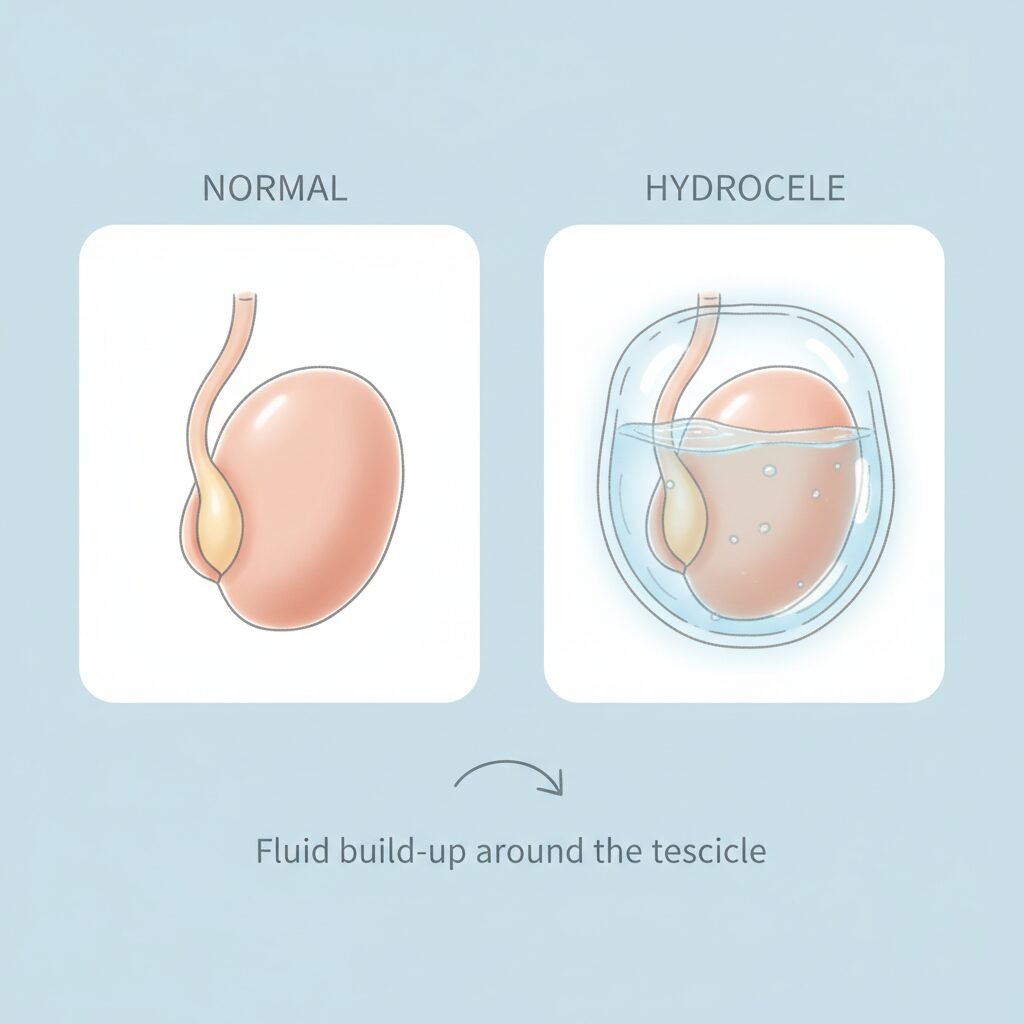
Alright, let’s demystify this. Imagine a tiny water balloon. That’s a pretty good way to picture a hydrocele. It’s simply a sac filled with clear fluid that forms around a testicle, making the scrotum look swollen and puffy. It’s one of the most common genital conditions found in newborn boys, affecting at least 1 in 10 full-term male infants, and even more in premature babies.
The important thing to remember is that a simple hydrocele is not a tumor, it’s not cancer, and it’s not causing your baby pain. He can pee just fine, and it won’t affect his future health or fertility. It’s just… fluid in a place you didn’t expect.
Two Types You Might Hear About
Your doctor might mention one of two types, and it’s helpful to know the difference in simple terms:
- Non-communicating Hydrocele: This is the most common type in newborns. Think of it as a closed-off water balloon. During development, a sac of fluid formed, and then the pathway to the abdomen closed up, trapping the fluid inside. The body just needs a little time to absorb this leftover fluid. It’s self-contained and the size usually stays consistent.
- Communicating Hydrocele: In this case, the little pathway (or channel) between the abdomen and the scrotum didn’t completely seal off after the testicles descended. This means that fluid from the abdomen can travel down into the scrotum and back again. If you have a baby with this type, you might notice that the swelling seems to get bigger when he’s active, crying, or straining, and then gets smaller when he’s resting or lying down. This type has a connection to inguinal hernias, which we’ll talk about later.
A Reassuring Note: Regardless of the type, the initial approach is the same: patience. Your baby’s body is amazing and is usually fully equipped to resolve this on its own without any intervention.
Why Does This Happen? A Quick Peek into Your Baby Boy’s Development

It can feel baffling why this happens, but it all goes back to the incredible journey your baby took before you even met him. Understanding the ‘why’ can be really reassuring.
Here’s a mini biology lesson, parent-to-parent style. While your baby boy was growing in the womb, his testicles didn’t start out in the scrotum. They actually developed way up high in his abdomen, near his kidneys. In the last couple of months of pregnancy, they begin a slow and steady migration downwards, through a small tunnel-like passage, to their final destination in the scrotum.
As each testicle descends, it brings a little bit of the abdominal lining with it, creating a sac (called the processus vaginalis). This sac is supposed to close up completely before or shortly after birth. A hydrocele occurs when one of two things happens:
- The sac closes, but some of the natural abdominal fluid gets trapped inside before the door shuts (this leads to a non-communicating hydrocele).
- The sac doesn’t close up properly, leaving a tiny open channel for fluid to move back and forth (this is a communicating hydrocele).
This is an incredibly common hiccup in the developmental process. It’s particularly prevalent in premature babies because their testicles had less time to complete their journey and for the passageway to seal off. So, if you had a preemie, the chances of seeing a hydrocele are significantly higher. It’s not a sign of anything being wrong; it’s just a sign that his little body had to finish some of its development on the ‘outside’.
The ‘Watchful Waiting’ Approach: Your Role at Home

So, your pediatrician has confirmed it’s a hydrocele and has likely used the phrase “watchful waiting.” This can feel a little anticlimactic. You want to do something! But in this case, the best course of action is patient, loving observation. Your primary job is to provide normal, everyday care and let your baby’s body do the work.
Your To-Do (and To-Don’t) List:
- Do: Continue with your normal diaper routine. Keep the area clean and dry to prevent diaper rash, just as you would anyway.
- Do: Give your baby plenty of cuddles, feedings, and love. Your normal care routine is all that’s needed.
- Do: Gently monitor the size. It can be helpful to take a quick, non-intrusive photo once a week (at the same time of day, like during the first morning diaper change) to track its progress. This gives you concrete information to share with your doctor at check-ups.
- Don’t: Try to squeeze, push, or drain the fluid. This is incredibly important. The scrotum and its contents are delicate. Attempting to reduce the swelling yourself can cause pain, serious injury, and infection.
- Don’t: Worry that you are hurting him by changing his diaper or letting him kick his legs. The fluid acts as a cushion, and normal movement and handling won’t cause him any pain.
Safety First: Please, never attempt any home remedies or try to drain the swelling. The risk of harming your baby is very high. Trust the process and your pediatrician’s guidance.
Most newborn hydroceles are like a puddle after a rainstorm—given enough time, the sun (or in this case, the body’s natural absorption process) will make it disappear. This usually happens within the first 12 months of life.
When to Call the Doctor: Red Flags vs. Normal Signs

“Watchful waiting” doesn’t mean you shouldn’t be watchful! While most hydroceles are harmless, it’s crucial to know the difference between a simple hydrocele and a more urgent issue, like an inguinal hernia or, very rarely, testicular torsion. An inguinal hernia is when a bit of intestine, not just fluid, pokes through that unclosed opening. Torsion is a twisting of the testicle that cuts off blood supply and is a true medical emergency.
Your parental gut instinct is powerful, so trust it. Here’s a table to help you distinguish what’s going on. If you see anything in the ‘Potential Problem’ column, don’t hesitate to call your pediatrician or seek immediate medical care.
| Symptom | Simple Hydrocele (What’s Expected) | Potential Problem (Call the Doctor!) |
|---|---|---|
| Swelling Appearance | Soft, smooth, like a small water balloon. May change size slightly. | Hard, firm, or seems tender to the touch. A sudden, significant increase in size. |
| Baby’s Mood | Content, happy, and acting like their usual self. | Crying inconsolably, seems to be in severe pain, especially when the area is touched. |
| Scrotum Color | Normal skin tone or may have a slight bluish tint from the fluid. | Redness, dark purple, or other significant discoloration. |
| Other Symptoms | None. Baby is eating and pooping normally. | Vomiting, fever, loss of appetite, or seems generally unwell. |
When It’s an Emergency: If you notice a sudden, hard, and painful swelling, especially if it’s accompanied by redness, vomiting, and inconsolable crying, this could be a sign of a strangulated hernia or testicular torsion. Do not wait. Contact your doctor immediately or go to the nearest emergency room.
At your check-up, the doctor will perform a simple physical exam. They might also shine a special light through the scrotum (a procedure called transillumination). With a simple hydrocele, the light will pass right through the clear fluid, making the scrotum glow. It’s a quick and painless way to confirm the diagnosis.
Looking Ahead: What Happens If It Lingers?

You’ve been watching and waiting, and your baby is approaching his first birthday. What if the swelling is still there? First, know that this is not uncommon. Some little bodies just take a bit longer to absorb the fluid or for the passageway to close.
Generally, pediatricians will continue to monitor the hydrocele until the baby is between 12 and 18 months old. If the hydrocele is still present after this time, if it’s a communicating type that is getting larger, or if it’s associated with an inguinal hernia, they may recommend a minor surgical procedure to correct it.
The word ‘surgery’ is terrifying for any parent, but let me reassure you about this specific procedure. It’s called a hydrocelectomy, and it is one of the most common and safest surgeries performed on children.
What the Surgery Involves:
- It’s typically an outpatient procedure, meaning you’ll likely go home the same day.
- A pediatric surgeon will make a very small incision, usually in a skin crease in the groin (not on the scrotum itself).
- The surgeon will then drain the fluid and close off the sac or the open passageway.
- The incision is closed with dissolvable stitches and is often covered with a small waterproof dressing.
Recovery is usually very quick. Your little guy might be a bit fussy for a day or two, but he’ll be back to his playful self in no time. The success rate is extremely high, and it permanently resolves the issue. While no parent wants their child to have surgery, it’s comforting to know that this is a routine, low-risk procedure designed to prevent any future complications. Your pediatrician and a pediatric urologist or surgeon will guide you through every step if this path becomes necessary.
Conclusion
Navigating the worries of new parenthood is a journey, and noticing something like a swollen scrotum on your perfect new baby is a definite bump in the road. But now you know what you’re looking at. A newborn hydrocele is a common, painless condition that, in most cases, is simply a temporary leftover from your baby’s amazing development. Your main job is to provide all the love and care you’re already giving, while keeping a gentle eye on things.
Remember the key takeaways: be patient, don’t try to fix it yourself, and know the red flags that warrant a call to your doctor. You noticed this because you are an attentive, caring parent. Trust that instinct. It’s your greatest superpower. Continue to partner with your pediatrician, ask all the questions you need to, and know that you and your baby are going to be just fine.