Goat vs. Cow: Is Goat Milk Formula the Secret Cure for Your Baby’s Tummy Troubles?
Late nights, endless crying, and that feeling of helplessness when you can’t soothe your baby’s discomfort—if this sounds familiar, you are not alone. As a new parent, you’d do anything to ease your little one’s pain. When you see them scrunching up their tiny legs, crying from gas, or spitting up after every feed, your heart breaks a little. In your search for solutions, you’ve probably heard whispers in parent groups or seen ads online for goat milk formula, often touted as a gentle, almost magical alternative for sensitive tummies. But is it really the secret cure you’ve been hoping for? Hello, I’m here to walk with you through this. As a pediatric nurse and lactation consultant, I’ve held the hands of countless worried parents just like you. Together, we’re going to cut through the marketing hype, look at what the science says, and help you make a calm, confident, and informed decision for the most important person in your world.
The Building Blocks: Cow’s Milk vs. Goat’s Milk Formula Explained
Before we dive into tummy troubles, let’s start with the basics. It’s crucial to know that any infant formula legally sold in the United States, whether its base is cow’s milk, goat’s milk, or soy, must meet the stringent nutritional requirements set by the FDA. This means your baby will get all the essential vitamins, minerals, proteins, fats, and carbohydrates they need to grow and thrive, no matter which you choose. The real differences lie in the structure of these core components.
The Protein Puzzle: Why Size Matters
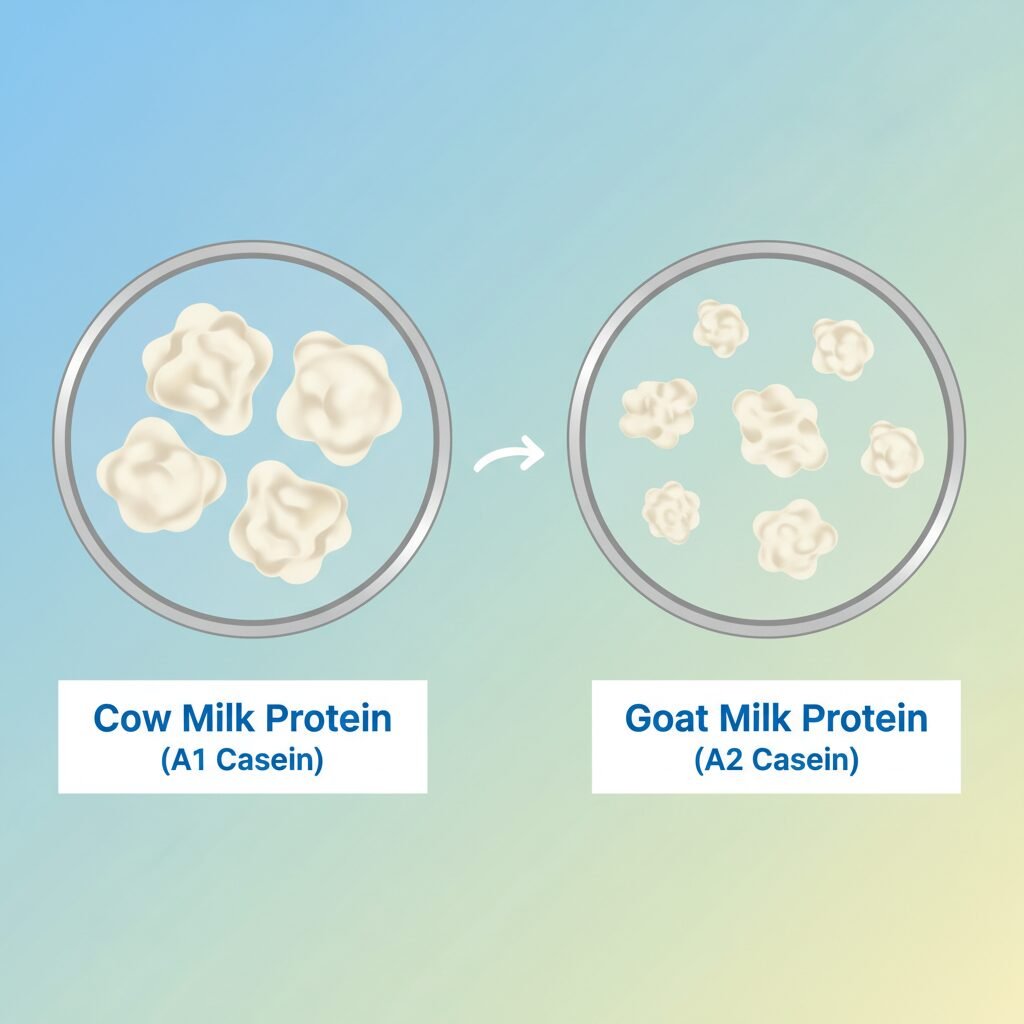
The most significant difference between cow and goat milk formula is the protein. Milk protein is made of two main types: casein and whey. While the whey-to-casein ratio is often adjusted in formulas to mimic breast milk, the type of casein protein is naturally different.
- Cow’s Milk Formula: Primarily contains a protein called A1 beta-casein. When this protein is digested, it can form larger, firmer curds in your baby’s stomach. For some infants, this can be a bit harder to break down, potentially leading to discomfort.
- Goat’s Milk Formula: Naturally contains almost exclusively A2 beta-casein. This is structurally more similar to the protein found in human breast milk. It forms smaller, softer, and more delicate curds in the tummy, which are generally easier for a baby’s developing digestive system to handle.
Fats and Carbohydrates: The Energy Source
The differences don’t stop at protein. The fat globules in goat’s milk are naturally smaller than those in cow’s milk. Goat’s milk also contains more medium-chain triglycerides (MCTs), a type of fat that can be more readily absorbed by the body. This can be another reason why some babies seem to digest it more easily. As for carbohydrates, the main source in both formulas is lactose. This is a very important point: goat milk formula is NOT a lactose-free option. If your baby has a true, diagnosed lactose intolerance (which is extremely rare in infants), goat milk formula will not be a suitable alternative.
Decoding the Cries: Common Causes of Infant Tummy Troubles

Hearing your baby cry is tough, but understanding why they’re crying is the first step toward finding a solution. It’s so important to remember that fussiness, gas, and spit-up are incredibly common in the first few months of life. Your baby’s digestive system is brand new and still learning how to do its job efficiently. It’s a huge learning curve!
Here are some of the most common culprits behind those tummy aches:
- An Immature Digestive System: This is the number one reason! The muscles aren’t fully coordinated, and they don’t have all the necessary gut bacteria yet.
- Swallowing Air: Babies can swallow a surprising amount of air during bottle-feeding (or even breastfeeding), especially if they have a shallow latch or are crying while eating. This trapped air leads to painful gas bubbles.
- Overstimulation: Sometimes, what looks like tummy pain is actually a baby who is overwhelmed by the sights and sounds of the world and needs a quiet, calm space.
- Food Sensitivities: This is different from a true allergy. A sensitivity means the baby’s system has a harder time breaking down a particular component, like the A1 casein protein in standard formula, leading to gas, bloating, or changes in stool.
A Critical Safety Note: A true Cow’s Milk Protein Allergy (CMPA) is a serious immune system reaction, not just a digestive issue. Symptoms can include hives, rashes, swelling, persistent vomiting, or blood or mucus in the stool. Because the proteins in cow’s milk and goat’s milk are very similar, most babies with a diagnosed CMPA will also react to goat’s milk. Goat milk formula is NOT a safe alternative for CMPA. If you suspect a true allergy, please speak with your pediatrician immediately.
Goat vs. Cow Formula: A Side-by-Side Comparison

Seeing all the details laid out side-by-side can make the choice feel much clearer. Let’s break down the key differences in a simple table so you can see how they stack up for your baby’s needs.
| Feature | Standard Cow Milk Formula | Goat Milk Formula | What This Means for Your Baby |
|---|---|---|---|
| Primary Protein Type | A1 Beta-Casein | A2 Beta-Casein | A2 protein is structurally more similar to human breast milk and may be gentler on a developing digestive system. |
| Protein Curd Size | Forms larger, firmer curds in the stomach. | Forms smaller, softer curds in the stomach. | Smaller, softer curds may be easier and quicker for your baby to digest, potentially reducing discomfort. |
| Fat Globule Size | Larger | Naturally smaller, with more MCTs. | Smaller fat globules and more easily absorbed fats might contribute to better digestive comfort. |
| Lactose Content | Contains lactose. | Contains lactose (at a slightly lower level). | Neither is suitable for a true lactose intolerance. The slight difference is usually not clinically significant. |
| Cost & Availability | Widely available and generally less expensive. | Less common in stores and typically more expensive. | Budget and accessibility are practical factors to consider for your family. |
| Suitability for CMPA | The cause of the allergy. | NOT a safe alternative. High risk of cross-reactivity. | If your baby has a diagnosed Cow’s Milk Protein Allergy, you will need a specialized hypoallergenic formula. |
Is Switching to Goat Milk Formula the Right Move for Your Family?

This is the million-dollar question, isn’t it? You’ve seen the science, but what does it mean for your baby, right now? The honest truth is: it depends. While there aren’t massive, conclusive clinical trials that declare goat milk formula a definitive cure for colic, the structural differences we’ve discussed are real. The A2 protein and smaller fat globules provide a strong scientific reason why it could be a gentler option for babies with general fussiness and mild digestive sensitivities (not allergies).
Many, many parents anecdotally report a significant improvement in their baby’s comfort, gas, and constipation after making the switch. For them, it felt like a miracle. For others, it makes no difference at all. It’s not a magic bullet, but it is a valid, nutritionally complete option to consider with your pediatrician.
A Quick Checklist to Help You Decide:
Consider trying goat milk formula if you can check off these boxes:
- Your baby is experiencing general fussiness, gas, constipation, or excessive spit-up that you suspect is related to feeding.
- You have already ruled out other issues and tried simple fixes like paced bottle feeding, frequent burping, and ensuring a good latch.
- Your baby does not have a diagnosed Cow’s Milk Protein Allergy (CMPA).
- You have discussed the switch with your pediatrician and they support you trying it.
- You are prepared for the higher cost and have confirmed you can consistently find and purchase the brand you choose.
A Gentle Transition: How to Safely Switch Formulas

If you and your pediatrician have decided to give goat milk formula a try, the next step is to make the switch smoothly to avoid upsetting your baby’s system even more. A slow and steady approach is always best.
First and foremost, a gentle reminder: Always consult your pediatrician before changing your baby’s formula. They know your baby’s health history and can provide the safest guidance.
Once you have the green light, follow these steps for a gentle transition. The goal is to do this over 5-7 days.
- Don’t Mix in the Same Bottle: Avoid mixing powders from two different formulas in the same bottle. This can throw off the precise nutritional balance. Instead, you’ll be alternating bottles of the old and new formula.
- Day 1-2: Start with One Bottle. Replace just one of your baby’s daily feedings with a full bottle of the new goat milk formula. See how they tolerate it. Keep all other feedings with the old formula.
- Day 3-4: Add a Second Bottle. If day one and two went well, you can now replace two feedings per day with the new formula. It’s often best to space them out (e.g., one in the morning, one in the evening).
- Day 5-7: Continue Gradually. Continue replacing one additional bottle each day until your baby is fully transitioned to the new goat milk formula.
During this time, pay close attention to your baby. Watch for changes in their mood, sleep, skin, and especially their diapers! It can take a baby’s digestive system up to two weeks to fully adjust to a new formula, so be patient. A little change in stool color or consistency is normal, but if you notice anything concerning, give your pediatrician’s office a call.
Conclusion
So, is goat milk formula the secret cure for your baby’s tummy troubles? The answer is a gentle ‘maybe.’ It is not a magic wand, but it is a scientifically sound option with a different protein and fat structure that can be genuinely easier for some babies to digest. For the infant with mild sensitivities, it can sometimes make all the difference, transforming fussy days into peaceful ones. However, it’s not a solution for true milk allergies and it isn’t necessary for every baby.
The most important thing to remember is that you are the expert on your child. The ‘best’ formula is the one that your baby tolerates well, that meets all their nutritional needs, and that helps them grow, thrive, and feel comfortable. Whether that’s a standard cow’s milk formula, a gentle or sensitive version, or a goat milk-based option, you are making a great choice. Trust your instincts, lean on your pediatrician as your partner in this journey, and give yourself so much grace. This phase of tummy troubles is temporary. You are doing an amazing job, and you’ve absolutely got this.