

Bulge in the Diaper Area? Identifying Inguinal Hernia in Babies
Hey there, new parent. Take a deep breath. I know that seeing something unusual on your perfect little baby, like a bulge near their groin, can send your heart into overdrive. Your mind starts racing with questions and worries, and that’s completely normal. As a pediatric nurse who has spent decades with new families, I’ve seen that look of concern many times. The good news is, you’ve come to the right place for clear, calm answers.
That little bulge could be something called an inguinal hernia. It’s a common condition in infants, and while it does require medical attention, it’s also very treatable. This guide is here to be your virtual hand-holder. We’ll walk through what it is, how to spot it, and what the next steps look like, so you can feel informed and empowered to care for your baby. Let’s get through this together.
First Things First: What Exactly Is an Inguinal Hernia?
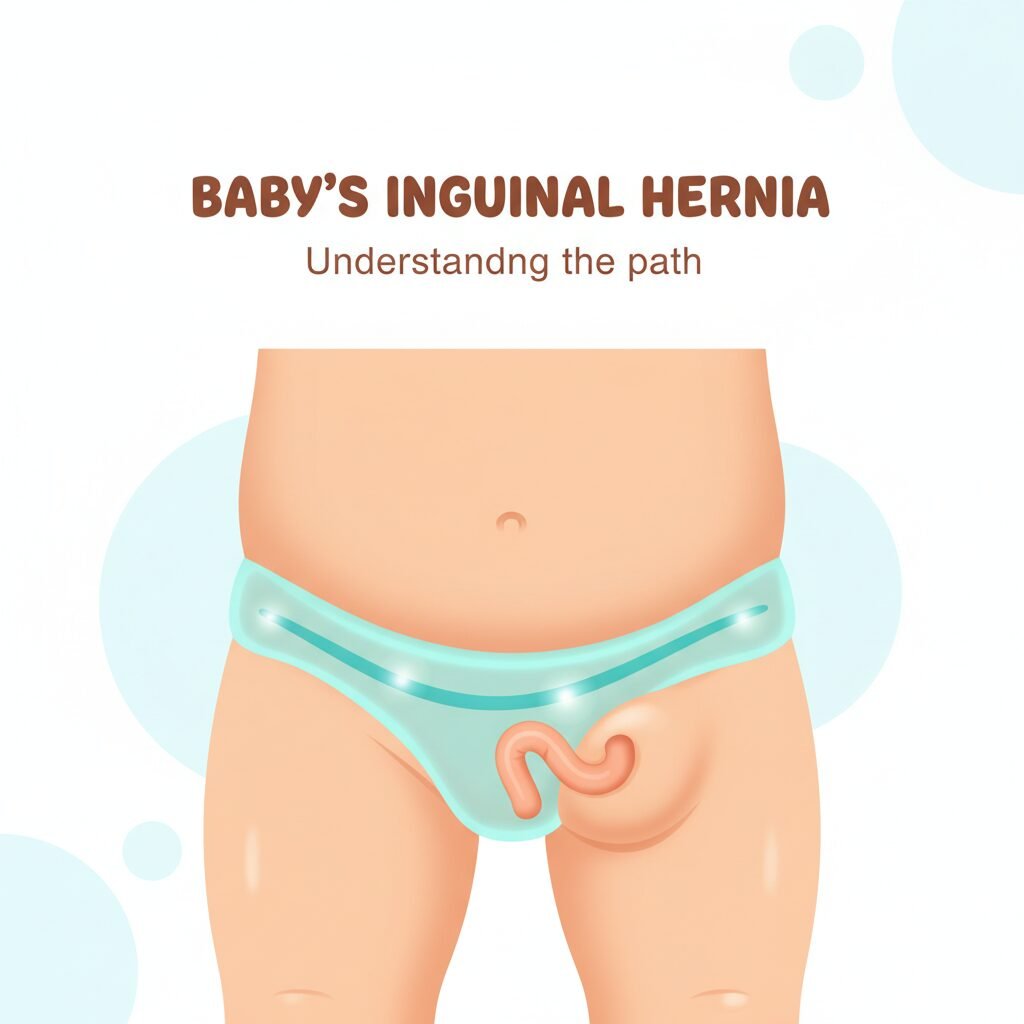
Before we dive into the signs, let’s understand what’s actually going on. It sounds like a complicated medical term, but the concept is pretty simple.
Imagine a tiny passageway between your baby’s abdomen and their groin area, called the inguinal canal. In many babies, especially boys, this canal is open at birth and closes on its own shortly after. An inguinal hernia happens when this opening doesn’t close up as it should. This leaves a small pathway where a piece of the intestine or abdominal fluid can slip through, creating a visible bulge. Think of it like a small hole in a tote bag where something from the inside can poke out a bit.
It’s important to know this is nothing you did wrong. It’s a developmental hiccup that is surprisingly common, affecting up to 5% of all full-term babies and as many as 30% of premature infants. It’s significantly more common in boys than in girls.
Two Types You Might Hear About
While your doctor will handle the specifics, you might hear these terms:
- Reducible Hernia: This is the most common type. It means the bulge might disappear when your baby is relaxed or lying down, and you might even be able to gently push it back in. It’s not an immediate emergency, but it does need to be seen by a doctor.
- Incarcerated Hernia: This is a more serious situation. It means the tissue is trapped in the groin and can’t be pushed back in. This requires urgent medical attention, which we’ll cover in detail later.
For now, just know that an inguinal hernia is a structural issue your baby was born with, and it has a very clear and effective solution.
Spotting the Signs: A Parent’s Guide to Identifying a Hernia

Your parent-radar is your best tool. You know your baby’s body better than anyone, so you’re the first line of defense in noticing when something is different. Here are the specific signs of an inguinal hernia to watch for:
- A Visible Bulge: The most obvious sign is a smooth, oval-shaped lump in the groin area, on either side of the pubic bone. In boys, this bulge can extend down into the scrotum, making one side look larger than the other.
- It Comes and Goes: The bulge isn’t always there. You’ll likely notice it most when there’s pressure on the abdomen.
- More Prominent with Straining: Look for the bulge to appear or get bigger when your baby is crying, coughing, straining during a bowel movement, or even kicking their legs energetically. When they calm down or relax, it often shrinks or disappears completely.
- It’s Usually Painless: For a simple, reducible hernia, the bulge itself shouldn’t be painful to the touch. Your baby should seem otherwise happy and comfortable.
A key piece of advice: A soft bulge that appears and disappears is your signal to schedule a non-urgent appointment with your pediatrician. It needs to be evaluated, but you don’t need to rush to the emergency room unless you see the ‘red flag’ symptoms we’ll discuss later.
When you check, use a gentle touch while your baby is calm, perhaps during a diaper change or after a warm bath. If the bulge is soft and easily goes back in, that’s important information for your doctor.
Your Pediatrician’s Visit: Getting a Diagnosis

Okay, so you’ve seen a bulge and you’ve made the call. Walking into the pediatrician’s office with a worry can be nerve-wracking, so let’s demystify what will happen during the visit. Knowing what to expect can make the whole process feel less intimidating.
The diagnosis for an inguinal hernia is usually very straightforward. Here’s the typical process:
- Medical History: Your doctor will start by asking you questions. When did you first notice the bulge? Does it come and go? Does it seem to bother your baby? Your observations are incredibly valuable, so don’t hesitate to share every detail.
- The Physical Exam: This is the most important part. Your doctor will gently examine your baby’s groin and abdomen. They’ll feel the area to confirm the presence of the hernia. They might hold your baby’s legs and have them ‘strain’ a bit to see if the bulge appears.
- Checking for Reducibility: The doctor will likely apply very gentle pressure to the bulge to see if it can be pushed back into the abdomen. This helps them confirm it’s a reducible hernia. This process shouldn’t hurt your baby.
In the vast majority of cases, a simple physical exam is all that’s needed to make a confident diagnosis. It’s rare to need further testing like an ultrasound, but your doctor might order one if the diagnosis isn’t completely clear.
The Next Step: Referral to a Specialist
Once the hernia is confirmed, your pediatrician will refer you to a pediatric surgeon. Please don’t let the word ‘surgeon’ scare you! Inguinal hernias don’t go away on their own and need a surgical procedure to fix the opening. A pediatric surgeon is a specialist who has extensive training in performing procedures on tiny bodies. They are the absolute experts in this field, and this type of repair is one of the most common surgeries they perform. Your baby will be in excellent hands.
The Path to Correction: Understanding Hernia Surgery and Recovery

Hearing that your baby needs surgery is tough. It’s okay to feel anxious. But hernia repair surgery (called a herniorrhaphy) is a very common, safe, and highly successful procedure. The goal is simple: to close the small opening and prevent any future problems.
What Happens During the Surgery?
The surgery is typically scheduled and isn’t an emergency procedure unless the hernia is incarcerated. It’s usually done on an outpatient basis, which means you’ll likely be able to take your baby home the very same day.
A pediatric anesthesiologist, a doctor specializing in giving anesthesia to children, will ensure your baby is safely asleep and comfortable throughout the procedure. The surgeon then makes a very small incision, often hidden in a skin crease in the groin. They gently place the tissue back into the abdomen and then stitch the opening in the muscle wall closed. The incision is then closed with dissolvable stitches or surgical glue.
Caring for Your Little One After Surgery
Your baby’s recovery will likely be much quicker than you imagine! Babies are incredibly resilient. Your surgical team will give you specific instructions, but here is a general idea of what to expect:
- Comfort: Your baby might be fussy or seem uncomfortable for a day or two. Your doctor will advise you on appropriate pain relief, such as infant acetaminophen or ibuprofen (if your baby is old enough).
- The Incision Site: You’ll need to keep the area clean and dry. You’ll likely be told to give sponge baths instead of tub baths for several days. There might be a little bruising or swelling, which is normal and will fade.
- Activity: The best part about babies is that they naturally limit their own activity! There are no major restrictions, but you’ll want to avoid putting pressure on their belly. Just lots of cuddles and gentle care.
- Feeding: Your baby should be able to return to their normal feeding schedule shortly after returning home.
Within a week or two, your little one will be back to their happy, wiggly self, and you’ll have the peace of mind knowing the problem is permanently fixed.
Urgent Signs: When to Call 911 or Go to the ER

This is the most important section of this guide. While most inguinal hernias are not emergencies, it’s critical to know the signs of a more serious problem, known as an incarcerated or strangulated hernia. This happens when the tissue gets trapped and the blood supply is cut off.
SAFETY WARNING: If you notice any of the following symptoms, this is a medical emergency. Do not wait. Go to the nearest emergency room or call 911 immediately.
- A Firm, Tender Bulge: The hernia becomes hard, swollen, and you can’t gently push it back in, even when your baby is calm and relaxed.
- Significant Pain: Your baby is crying inconsolably and seems to be in severe pain.
- Redness or Discoloration: The skin over the bulge looks red, purplish, or darker than usual.
- Vomiting: Especially if the vomit is green or yellow-ish (bilious).
- Swollen or Full Abdomen: Your baby’s belly looks bloated.
- Fever: Any fever accompanying these other symptoms is a major red flag.
- Refusing to Feed or Lethargy: A sudden change in your baby’s behavior, where they won’t eat or are unusually sleepy and unresponsive.
Trust your instincts. If your baby seems acutely ill and has a hernia, it’s always better to be safe and seek immediate medical care.
Conclusion
Finding a lump on your baby is a heart-stopping moment, but now you are armed with knowledge and a clear plan. An inguinal hernia is a common detour on the journey of babyhood, but it’s one with a very clear, safe, and effective roadmap to resolution. You’ve learned how to identify it, what to expect at the doctor’s office, and how straightforward the treatment is.
Most importantly, you’ve learned to trust your incredible parental intuition. Noticing that small bulge was the first and most critical step in getting your baby the care they need. You are their greatest protector and advocate. Continue to trust that gut feeling, ask questions, and lean on your medical team. You and your baby have got this, and on the other side of this small bump in the road are countless days of happy, healthy wiggles and giggles.