
Baby Wearing Made Easy: How To Master The Moby Wrap In 60 Seconds
Hello, dear new parent. Take a deep breath. I see you. As a pediatric nurse and lactation consultant, I’ve sat with hundreds of parents just like you, navigating the beautiful, chaotic, and utterly overwhelming first few weeks with a new baby. You want to hold them close every second, but you also need to pour a glass of water, answer an email, or maybe even just brush your teeth. What if I told you there’s a way to do both?
Welcome to the wonderful world of babywearing! It’s like a superpower for parents, allowing you to keep your baby snuggled, safe, and content right where they want to be—with you—while giving you your hands back. The Moby Wrap is a fantastic tool for this, creating a womb-like environment that soothes even the fussiest newborns. But let’s be honest: that giant strip of fabric can look more like a magic trick than a baby carrier.
Don’t worry. My goal is to demystify it completely. Forget the confusing tutorials. We are going to make this simple, safe, and fast. Ready to master the Moby Wrap and reclaim your hands? Let’s do it together.
More Than Just a Carrier: The Amazing Benefits of Babywearing

Before we get into the ‘how-to,’ let’s talk about the ‘why.’ Understanding the incredible benefits of keeping your baby close can be a huge motivator when you’re learning a new skill. Babywearing isn’t just a trend; it’s an age-old practice backed by modern science.
Think about your baby’s first three months outside the womb as the ‘fourth trimester.’ They’ve just left a warm, dark, snug environment where they were constantly held and rocked. The world is bright, loud, and wide open! Babywearing helps ease this transition by recreating that feeling of security.
Benefits for Your Baby:
- Less Crying: It’s true! Research has shown that babies who are carried for at least three hours a day cry significantly less than babies who aren’t. They are calmer because their core needs are being met.
- Promotes Healthy Development: The soft, flexible support of a wrap like the Moby encourages the natural C-shaped curve of a newborn’s spine and the M-shaped position of their legs, which is crucial for healthy hip development. It also helps strengthen their neck muscles as they begin to gain head control.
- Better Sleep: The gentle motion and your familiar heartbeat often lull babies into a peaceful sleep, which means more rest for everyone.
- Aids Digestion: Keeping your baby in an upright position can be a game-changer for little ones struggling with reflux or gas. Gravity helps keep things down!
Benefits for You:
- Freedom and Flexibility: This is the big one! You get two free hands to make a sandwich, tidy up, work from home, or care for other children, all while your baby is happily snuggled.
- Enhanced Bonding: Being physically close to your baby releases oxytocin (the ‘love hormone’) for both of you, strengthening your connection and helping you learn their cues more intuitively.
- Supports Postpartum Wellness: For many new parents, the ability to get up and move around while keeping baby close can be a gentle way to ease back into activity and can have a positive impact on mental and emotional health.
- Easy Nursing Access: With a little practice, a stretchy wrap can become a discreet and supportive tool for on-the-go breastfeeding.
Safety First! The T.I.C.K.S. Rule for Safe Babywearing

Okay, before we wrap, we need to talk about the most important thing: safety. Keeping your baby secure is non-negotiable, but it’s also not complicated! The best way to remember the key safety points is with a simple acronym: T.I.C.K.S. Commit this to memory, and you’ll always be able to check that your baby is positioned correctly.
The T.I.C.K.S. Checklist:
- T is for TIGHT: The wrap should be tied snugly around you and your baby. It should feel like a firm hug. If it’s too loose, your baby can slump down, which can compromise their airway. A good test is to gently press on your baby’s back; they should not uncurl or move further away from your body.
- I is for IN VIEW AT ALL TIMES: You should be able to glance down and see your baby’s face. The fabric should never be completely covering their head or face. This is crucial for monitoring their breathing.
- C is for CLOSE ENOUGH TO KISS: Your baby should be positioned high up on your chest. You should be able to tip your head forward and easily kiss the top of their head. If they’re too low, it’s a sign the wrap isn’t tight enough.
- K is for KEEP CHIN OFF CHEST: This is the most critical rule. A baby’s airway is delicate. You must ensure their chin is not curled down onto their chest, as this can restrict their breathing. Always make sure you can fit at least one to two adult fingers between their chin and their chest.
- S is for SUPPORTED BACK: The wrap should support your baby’s back in its natural, gently rounded position (a ‘C’ shape). Their tummy and chest should be pressed comfortably against you.
A Crucial Safety Note: Always monitor your baby’s breathing. Listen for soft, regular breaths and check on them frequently, especially when they are a tiny newborn. Never jog, run, or perform any activity that could shake or injure your baby while they are in the carrier.
Also, pay attention to their little legs! You want them in a frog-like, ‘M’ position, where their knees are higher than their bottom. This is the optimal position for healthy hip development.
Let’s Get Wrapping! The 60-Second Moby ‘Newborn Hug Hold’
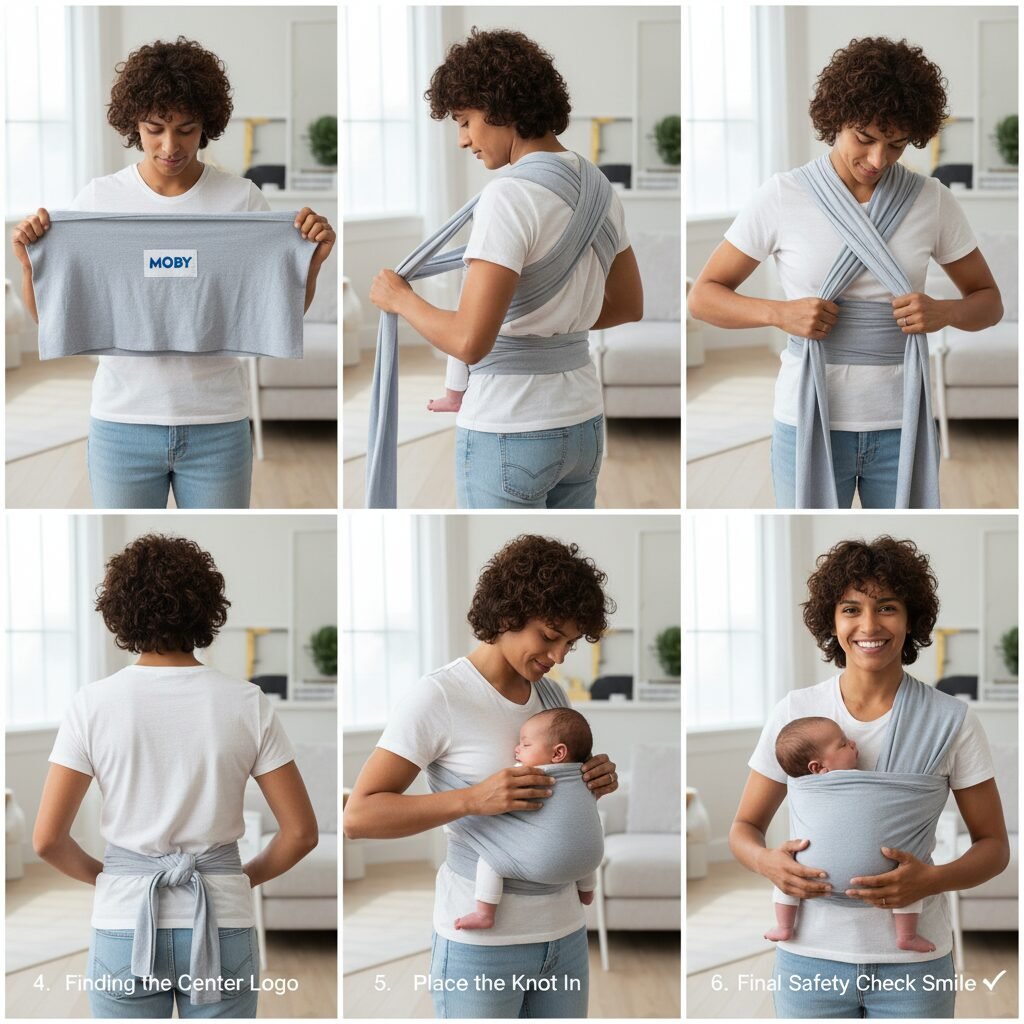
Alright, it’s time for the main event! Find your Moby Wrap, take another deep breath, and let’s walk through this together. It might feel a bit clumsy the first two or three times, but I promise it will soon become muscle memory. Think of it like learning to tie your shoes—awkward at first, then you can do it without even thinking. We’re aiming for the classic ‘Newborn Hug Hold,’ which is perfect for your little one.
- Find the Center: Unfurl your Moby Wrap. Find the little logo right in the middle of the fabric. Place that logo flat against the center of your chest, like you’re putting on an apron.
- Create the ‘X’ on Your Back: Take the two long ends (we’ll call them panels) and bring one over each shoulder to your back. The panels will cross over each other on your back, forming a big ‘X’. Keep the fabric flat and untwisted—this prevents uncomfortable digging later.
- Tuck and Tighten: Bring both panels back down to the front. Now, tuck both of those panels underneath that first piece of fabric with the logo on it. Pull down firmly to tighten everything up. The ‘X’ on your back should feel snug, and the front panel should be taut across your chest. This is the most common mistake: new users don’t pull it tight enough here! It should feel tighter than you think you need.
- Cross and Tie: Now, take the two long panels hanging down and cross them over each other, creating another ‘X’ where your baby will sit. Then, bring the panels around your waist to your back and tie a secure double knot. If you have a lot of extra fabric, you can bring it back to the front or side to tie the knot. The wrap is now on and ready for baby!
- Place Your Baby In: Pick up your baby and hold them against the shoulder opposite the innermost front panel. Gently slide your baby’s leg and body through that inside panel. The fabric should go from their knee pit to their other knee pit and up their back. Then, do the same with the other, outer panel. Spread the fabric wide to create a deep, secure seat. Their legs should be in that hip-healthy ‘M’ position.
- Secure and Safety Check: Finally, find the front panel with the logo on it. Pull it up and over your baby’s back, all the way up to their neck for support. Their little feet can either be tucked inside or stick out the bottom. Now, run through your T.I.C.K.S. checklist one last time. Is the wrap tight? Can you see their face? Are they close enough to kiss? Is their chin off their chest? Is their back supported? If yes, congratulations! You just did it!
Troubleshooting Common Moby Wrap Woes
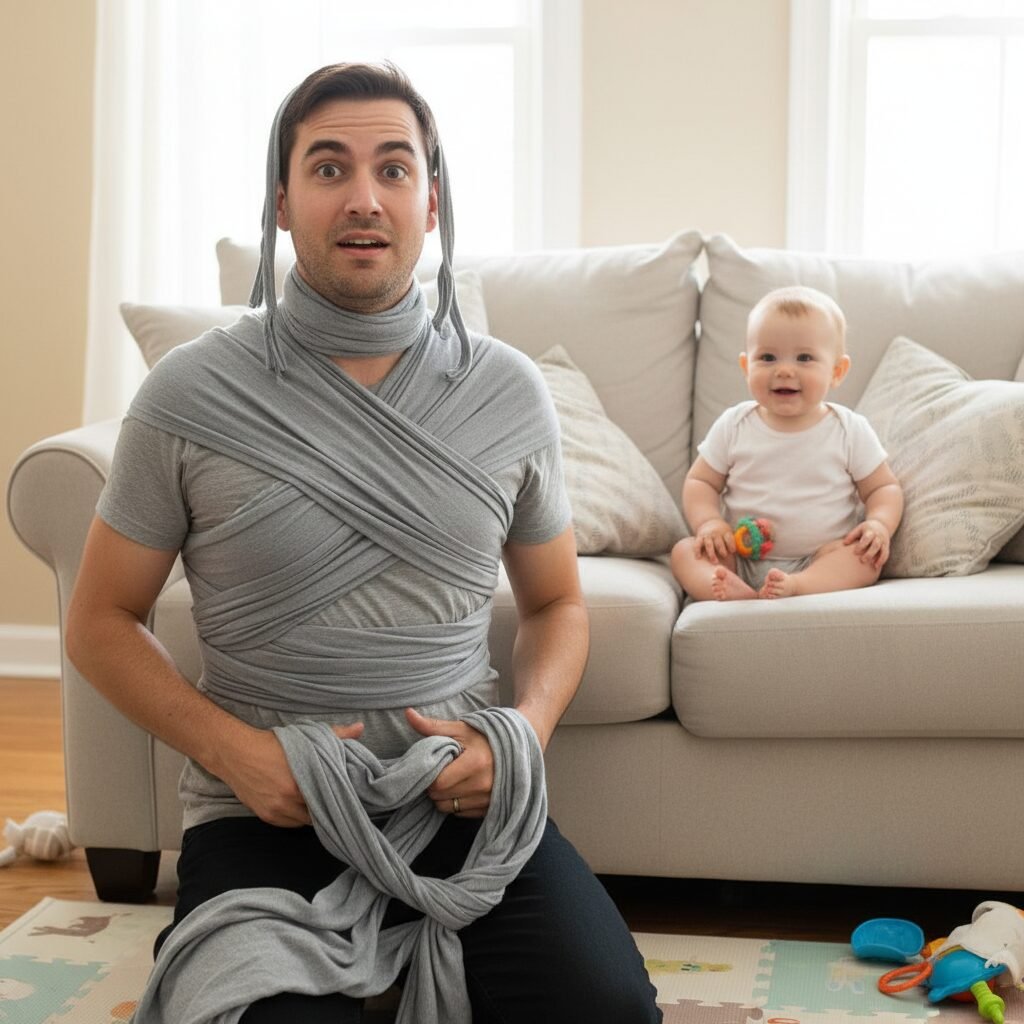
If it didn’t feel perfect on the first try, please don’t be discouraged! Every single babywearing parent has been there. Here are some of the most common hiccups and how to fix them. You’re not alone in this!
‘My wrap feels too loose and my baby is sagging down to my belly button!’
This is, without a doubt, the number one issue. The solution is almost always to tie the wrap tighter before you put the baby in. The stretchy fabric is very forgiving, and it needs to feel snug—like a tight-fitting t-shirt—before you even pick up your baby. When you pull the panels down in Step 3, give them a really good tug. Don’t be shy!
‘The fabric feels overwhelming and it keeps dragging on the floor!’
That long fabric can feel like a lot to manage, especially when you’re trying not to let it touch a dirty parking lot floor. A great trick is to practice while sitting on your bed or couch. This way, the ends are contained. You can also try folding the wrap in half lengthwise (like a hot dog bun) before you start, which can make the fabric feel less bulky and more manageable.
‘My baby starts fussing the moment I put them in!’
First, run through the comfort checklist: are they hungry, tired, or do they need a diaper change? If their basic needs are met, the magic ingredient is often motion. Most babies don’t love being put into a wrap and then standing still. As soon as your baby is secure, start walking. Bounce gently, sway, walk around the house. The movement is incredibly soothing and usually calms them right down.
‘I’m worried my baby is getting too hot in there.’
That’s a valid concern! Remember that the wrap itself counts as at least one layer of clothing—and with three panels over the baby in the Newborn Hug Hold, it can be more like three thin layers. Dress your baby (and yourself) accordingly. In warmer weather, just a diaper or a light onesie is plenty for baby. To check if they’re too warm, feel the nape of their neck. If it’s sweaty, they’re too hot.
Conclusion
You did it! See? That long piece of fabric isn’t so scary after all. It’s a tool, and like any tool, it just takes a little bit of practice to feel like an extension of you. Be patient with yourself and with your baby. Some days they’ll love it, and other days they might prefer your arms—and that’s okay.
The Moby Wrap can be an incredible key to unlocking a bit more freedom in your day while providing the closeness and security your newborn craves. It allows you to meet their needs and your own, all at the same time. That’s not just a parenting hack; it’s a gift.
So keep practicing, trust your instincts, and always run through your safety checks. Before you know it, you’ll be wrapping your baby in 60 seconds flat, ready to take on the day together. Happy wrapping, and please, soak in every single one of those precious snuggles. They go by so fast.