

Angel Kisses: Will These Red Marks On Baby’s Face Fade?
When you first hold your newborn, you spend hours memorizing every tiny detail—the curve of their nose, the ten perfect toes, the impossibly soft hair. So, when you notice a little pink or reddish patch on their delicate skin, it’s natural for your heart to skip a beat. What is that? Is it a rash? Did I do something wrong?
Take a deep, calming breath, new parent. As a pediatric nurse and lactation consultant, I’ve reassured countless parents about these very same marks. What you’re likely seeing is an incredibly common and completely harmless birthmark lovingly nicknamed an ‘angel kiss’ or a ‘stork bite.’
These sweet little spots are part of the newborn story for so many babies. In this guide, we’ll walk through exactly what they are, the simple science behind them, and answer that all-important question you’re asking: will they fade away? Let’s get you the peace of mind you deserve.
Unpacking the Mystery: What Are Angel Kisses and Stork Bites?
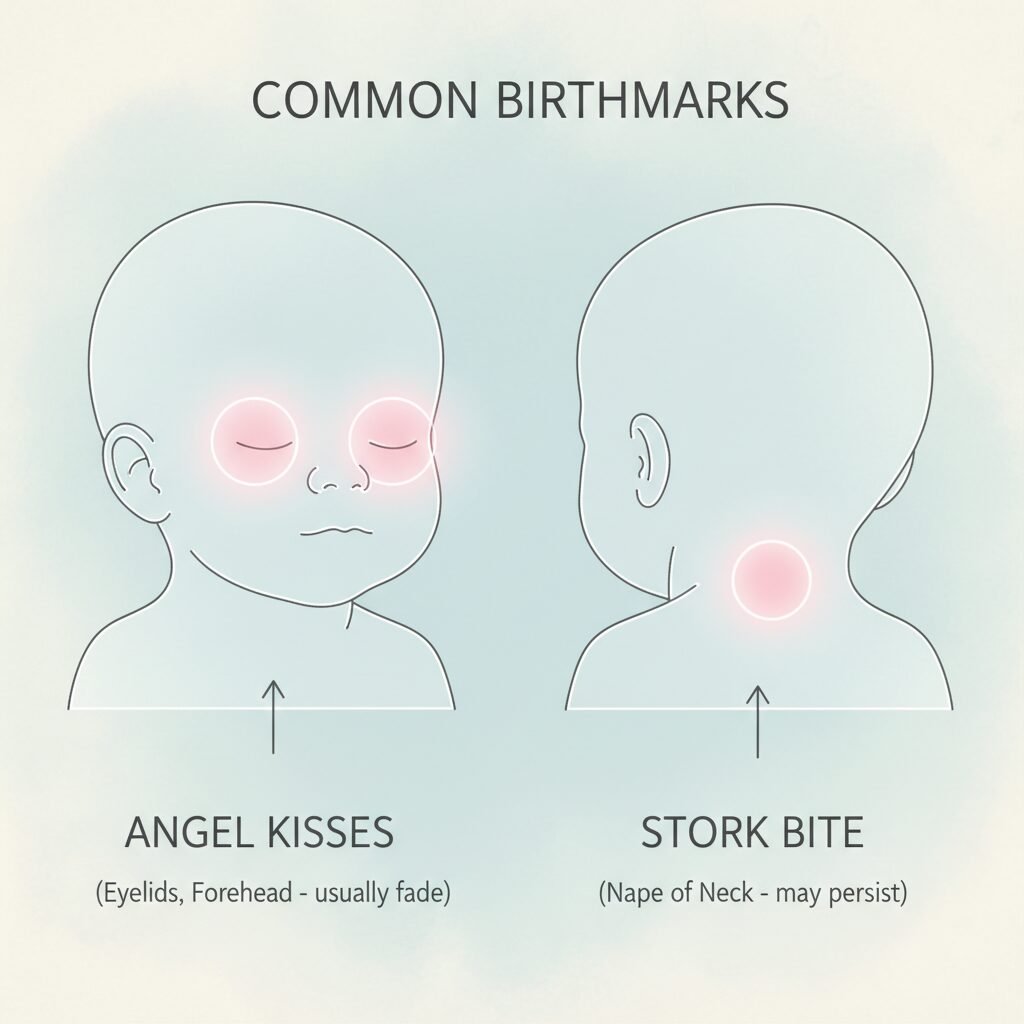
First things first, let’s give these marks their proper name. Medically, they’re known as nevus simplex, or a salmon patch (a pretty descriptive name, right?). But ‘angel kiss’ and ‘stork bite’ are just so much sweeter. They are, by far, one of the most common types of birthmarks a baby can have, appearing in as many as 30-50% of all newborns.
So what are they? They aren’t a rash, an allergy, or an injury. They are simply a collection of tiny, stretched-out blood vessels, called capillaries, that are visible through your baby’s very thin and delicate skin. They are completely flat—if you run your finger over one, you won’t feel a thing.
Location, Location, Location
The cute nickname simply depends on where the mark appears:
- Angel Kisses: These are the marks found on your baby’s face, most commonly on the forehead (especially between the eyebrows), eyelids, or the tip of the nose. The folklore says these are where an angel kissed the baby goodbye before they came to you.
- Stork Bites: This is the name for the exact same type of mark when it appears on the back of the baby’s neck, right at the hairline. The old tale suggests this is where the mythical stork carried the baby in its beak during delivery.
One of the tell-tale signs of an angel kiss is that it often becomes more noticeable when your baby is warm, crying, or straining (like during a bowel movement). This is because the increased blood flow makes those little capillaries stand out more. When your baby is calm and cool, the mark will likely appear much fainter. This fluctuation is totally normal and a key indicator that it’s just a harmless nevus simplex.
A Reassuring Thought: These marks are painless, they don’t itch, and they are not a sign of any underlying health problem. They are just a unique, temporary part of your baby’s brand-new skin.
The Fading Game: What to Expect as Your Baby Grows

This is the question every parent asks, and I’m happy to bring you some very good news. The answer depends on the location of the mark, but for the most part, you can expect these sweet spots to fade significantly or disappear entirely.
Angel Kisses on the Face
The marks on your baby’s face—the true ‘angel kisses’—have a fantastic track record of fading away. Because the skin on the face thickens and matures quite a bit during the first couple of years, it gradually hides those little surface capillaries from view.
- Timeline: Most angel kisses on the forehead, nose, and eyelids will fade dramatically within the first 12 to 24 months.
- What to Expect: You’ll likely notice the mark getting progressively lighter over time. It might still pop out a bit when your toddler has a big crying spell, but for daily appearances, it will become a faint memory. The vast majority disappear completely.
Stork Bites on the Neck
The marks on the back of the neck are a little more stubborn. While many stork bites do fade over time, a good number of them can persist into adulthood. The good news? They are located right at the hairline. As your child’s hair grows, the mark becomes completely covered and is rarely ever noticeable.
Here’s a simple breakdown to help you visualize the timeline:
| Mark Location | Typical Fading Timeline | Long-Term Outlook |
|---|---|---|
| Angel Kiss (Forehead, Eyelids, Nose) | Significantly fades within 1-2 years | Almost always disappears completely. |
| Stork Bite (Back of Neck) | May fade, but often persists | Often remains into adulthood but is typically covered by hair. |
So, while you might be focused on it now, rest assured that the angel kiss on your baby’s eyelid won’t be a feature they carry with them to their high school graduation. It’s a fleeting part of their infancy.
Is It an Angel Kiss or Something Else? A Simple Guide
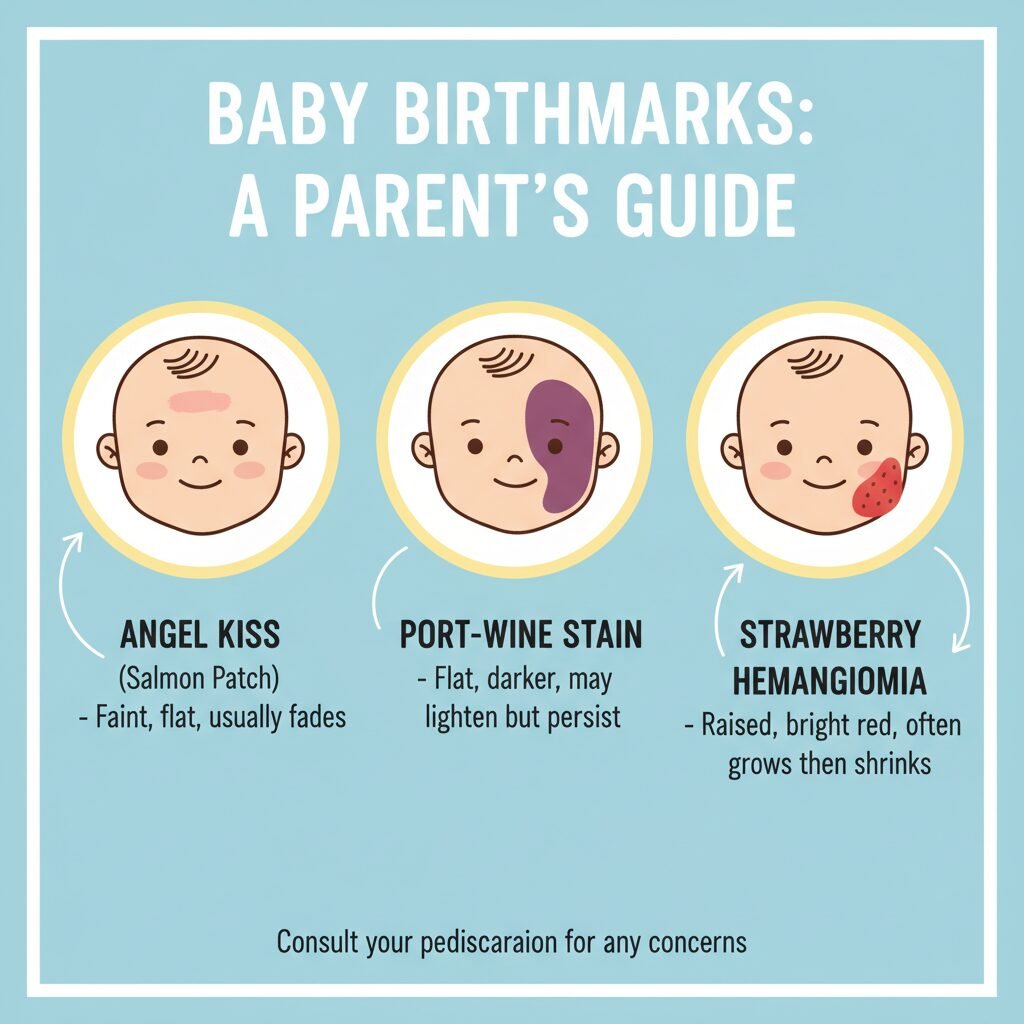
While angel kisses are super common, there are a few other types of red birthmarks. Knowing the difference can give you even more peace of mind. Here’s a quick guide to distinguishing between them. Remember, your pediatrician is always your best resource for a definitive diagnosis!
Angel Kiss / Stork Bite (Nevus Simplex)
- Appearance: Flat, pinkish-red, with uneven or feathery borders.
- Behavior: Blanches (turns white) when you gently press on it. May look darker when baby cries.
- Outlook: Facial marks fade; neck marks may persist.
Port-Wine Stain (Nevus Flammeus)
- Appearance: A flat mark that is usually darker—ranging from dark pink to a deep red or purple. It has very sharp, well-defined borders.
- Behavior: Does not blanch when pressed. It will grow in proportion to your child and darken over time.
- Outlook: These are permanent and do not fade on their own. It’s important to have a doctor evaluate a port-wine stain, as they can sometimes be associated with other medical conditions.
Infantile Hemangioma (“Strawberry” Mark)
- Appearance: Often not present at birth, but appears in the first few weeks of life. It’s a raised, bright red, bumpy mark that looks a bit like the surface of a strawberry.
- Behavior: It goes through a rapid growth phase for the first few months, then stabilizes, and finally begins to shrink and fade over several years.
- Outlook: Most go away on their own, but any hemangioma, especially one near the eyes, nose, or mouth, should be monitored by a pediatrician.
This table can help you quickly compare the key differences:
| Mark Type | Appearance | Fading Pattern | When to See a Doctor |
|---|---|---|---|
| Angel Kiss/Stork Bite | Flat, pink/red, irregular borders, blanches when pressed. | Fades over 1-2 years (face), or may persist (neck). | Mention during regular well-child check-ups for confirmation. |
| Port-Wine Stain | Flat, dark red/purple, sharp borders, does not blanch. | Permanent; grows with the child and may darken. | Always see a doctor for diagnosis and to rule out related issues. |
| Infantile Hemangioma | Raised, bright red, bumpy texture, often appears after birth. | Grows for a few months, then slowly shrinks over several years. | Always see a doctor, especially if it’s large or near the eyes/mouth. |
Caring for Your Baby’s Skin and When to Chat with Your Doctor

One of the best things about angel kisses is how low-maintenance they are. The care instructions are simple: do nothing!
Everyday Care
You don’t need any special creams, ointments, or treatments for an angel kiss or stork bite. Just care for your baby’s skin as you normally would. Gentle cleansers and regular baths are all that’s needed. The mark is a part of their skin, not something on top of it, so there’s no need to scrub or treat it differently.
When to Make the Call
While 99% of these marks are just sweet, harmless angel kisses, it’s always best to be informed. Your pediatrician will likely notice and identify the mark at your baby’s first check-up. However, you should definitely reach out to them if you notice any of the following:
- The mark seems raised, bumpy, or has a rough texture.
- The mark appears to be growing larger, thicker, or getting significantly darker.
- You notice any other birthmarks, especially if there are many of them.
- A red mark is located along the midline of your baby’s lower back, over the spine.
Your Peace of Mind Is a Priority: Never, ever feel silly for calling your doctor. You are your baby’s best advocate, and your intuition is powerful. If you are worried about anything—a mark on their skin or the color of their poop—a quick call for reassurance is always the right choice.
Trust your instincts. A quick conversation with a healthcare professional can ease your mind and let you get back to what’s most important: enjoying those newborn cuddles.
Conclusion
So, those little pink patches are not a cause for alarm, but rather a sweet, fleeting characteristic of your brand-new baby. Think of them as a temporary little love note, a unique mark that, for a short time, is all their own. Angel kisses are a perfect reminder of how delicate and new your little one is, with skin still so transparent you can see the tiny vessels that give them their rosy glow.
You can rest easy knowing that the marks on your baby’s beautiful face will almost certainly be a distant memory by the time they are running around and getting into toddler mischief. For now, cherish every detail. Take the pictures, snuggle them close, and know that you’re doing a wonderful job navigating this incredible journey of parenthood.