

The Exact Night Shift Schedule That Saved Our Marriage After Baby
Hey there, new parents. Let’s have a real talk. Are you currently running on fumes, caffeine, and the occasional desperate, tear-filled glance at your partner? If the phrase “I’m so tired” has replaced “I love you” as your most-used phrase, you are in the right place. The newborn phase is a beautiful, messy, magical blur, but it can also be an absolute wrecking ball to your sleep and, let’s be honest, your relationship.
We’ve all heard the well-meaning advice: “Sleep when the baby sleeps.” It sounds lovely, doesn’t it? But it rarely accounts for the mountain of laundry, the need to shower, the desire to eat a meal with two hands, or the simple fact that you might just want to stare at a wall for ten minutes in complete silence. When both parents are trying to catch fragments of sleep whenever possible, exhaustion builds, resentment simmers, and communication breaks down. That’s where we were—two ships passing in the night, both feeling overwhelmed and under-supported.
But we found a way through it. It wasn’t a magic wand, but it was the next best thing: a structured night shift schedule. This system didn’t just help us get more sleep; it transformed us back into a team. It gave us predictability in a chaotic time and, truly, it felt like it saved our marriage. In this article, I’m going to lay out the exact schedule we used, the ground rules that made it work, and how you can adapt it for your own family. Get ready to reclaim your nights and reconnect with your partner.
The Unspoken Truth: Why ‘Sleep When Baby Sleeps’ Fails New Parents

Before we dive into the solution, let’s get real about why the most common piece of newborn advice often falls flat. The ‘sleep when the baby sleeps’ mantra comes from a good place, but it’s a relic of a bygone era, one that didn’t fully grasp the complexities of modern parenting and the importance of mental health.
The Myth of Restful Naps
A newborn’s sleep is erratic and short. They might sleep for 20 minutes or two hours. Trying to align your own deep sleep cycle with this unpredictable schedule is a recipe for frustration. Just as you finally drift off, the baby stirs. This fragmented sleep is not restorative. It’s low-quality, anxiety-ridden rest that leaves you feeling groggy and on edge, not refreshed.
The Invisible Workload
A sleeping baby doesn’t mean the work stops. There are bottles to wash, pump parts to sterilize, laundry to fold, and meals to prepare. For the parent at home, a baby’s nap is often the *only* time to tackle these essential tasks. Choosing between sleep and a semblance of order in your home is a constant battle, and it’s one that breeds exhaustion no matter which you choose.
The Resentment Trap
When both parents are equally sleep-deprived and operating in survival mode, it’s easy to start keeping score. “I was up three times last night.” “Well, I was up at 5 AM and did all the morning chores.” This kind of thinking, fueled by sheer exhaustion, creates a divide. You stop seeing each other as partners in the same struggle and start seeing each other as part of the problem. This is the danger zone where communication breaks down and resentment builds. A structured system removes this scorekeeping by creating clear roles and responsibilities, ensuring both partners feel their need for rest is valued and protected.
A quick note: This isn’t about blaming your partner. It’s about recognizing that the system—or lack thereof—is failing you both. You need a new game plan that prioritizes protected, uninterrupted sleep for each of you.
The Ground Rules: Core Principles of Our Marriage-Saving Night Shift System

A schedule is just a piece of paper without a shared understanding of how to make it work. Before you even discuss times, you need to agree on the fundamental principles. These are the non-negotiables that turn a simple schedule into a powerful tool for teamwork and support.
Rule #1: Divide and Conquer (For Real)
This is the most important rule. When one person is ‘on duty,’ they are 100% responsible for the baby. Changing, feeding, burping, soothing—it’s all on them. When a person is ‘off duty,’ their only job is to sleep. The on-duty parent does not wake the off-duty parent unless it is a genuine emergency. No questions about where the diapers are, no requests for help with a fussy baby. The off-duty time is sacred sleep time.
Safety Tip: To make this work, the off-duty parent might need to sleep in a separate room with a white noise machine and earplugs. This isn’t a sign of a bad marriage; it’s a sign of a smart, strategic partnership committed to getting real rest.
Rule #2: Prepare Your Stations
The middle of the night is not the time to be fumbling for supplies. Before the first shift begins, the on-duty parent should set up their ‘station.’ This could be in the nursery or the living room. It should include:
- A basket with diapers, wipes, and diaper cream.
- Pre-portioned formula or bottles of pumped breast milk.
- A bottle warmer, if you use one.
- Burp cloths.
- A change of clothes for the baby (and maybe one for you!).
- A large water bottle and some quiet snacks for the parent.
- Your phone charger and headphones.
Having everything within arm’s reach minimizes disruption and stress, making the shift much more manageable.
Rule #3: Communicate with Kindness
Check in with each other every day. How did the shift go? Are the times working? Does anything need to be adjusted? Be flexible. Some nights are harder than others. If one parent had a brutal shift, maybe the other can take the baby for an extra 30 minutes in the morning so they can have a proper shower. Lead with empathy and remember you’re on the same team. This isn’t a business transaction; it’s a compassionate agreement to care for each other and your baby.
The Golden Ticket: Our Exact ‘Anchor Sleep’ Night Shift Schedule
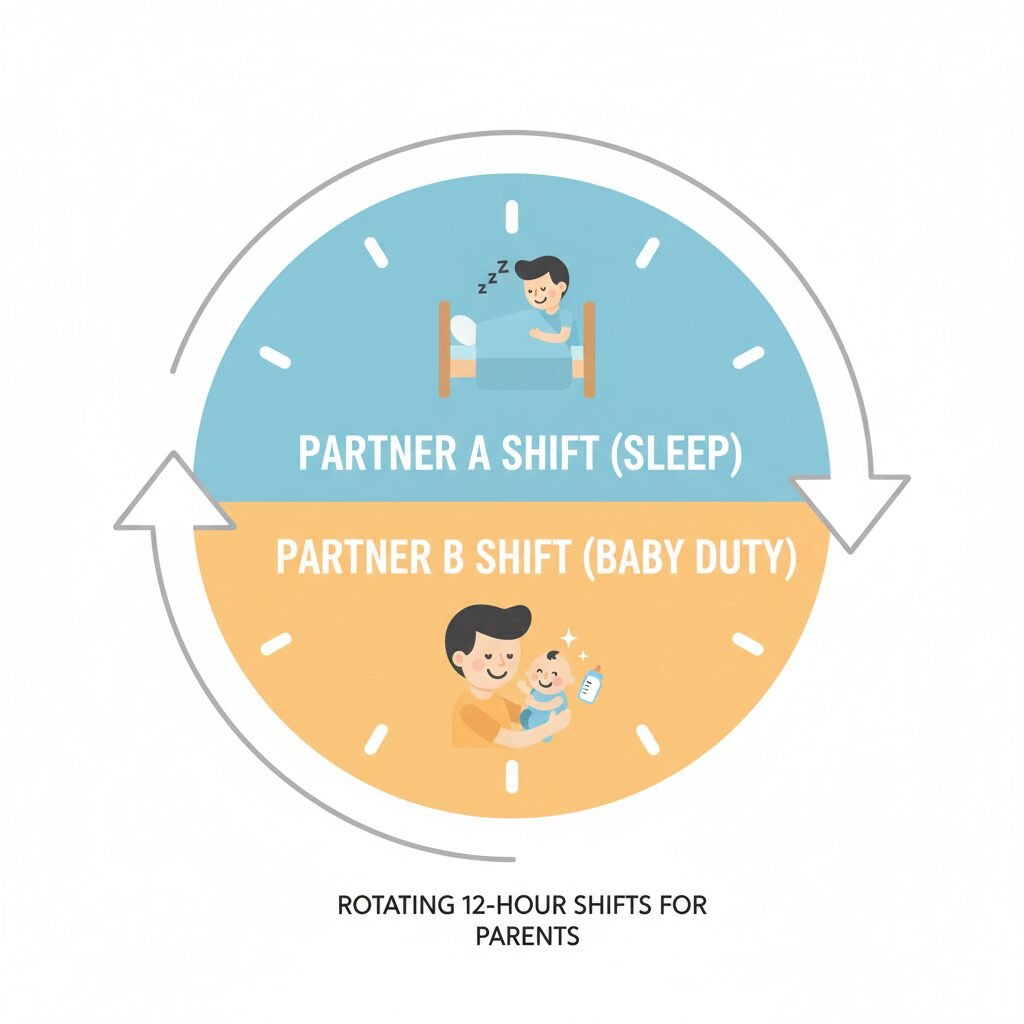
Okay, here it is—the practical, tactical schedule that gave us our sanity back. We called it the ‘Anchor Sleep’ method because its primary goal is to give each parent one solid, uninterrupted ‘anchor’ block of sleep. This is what allows your brain and body to truly recover. Remember, this is a template! Adjust the times to fit your family’s natural rhythm.
Phase 1: The Early Weeks (Approx. 0-6 Weeks)
In the very beginning, newborns eat every 2-3 hours, so shifts are shorter and more intense. The goal here is a solid 4-5 hour chunk of sleep for each parent.
| Time | Parent A | Parent B |
|---|---|---|
| 8:00 PM | Goes to bed. This is their sacred, off-duty sleep time. No interruptions! | On duty. Handles all baby care. Feeds, changes, and soothes the baby. |
| 1:00 AM | Wakes up for their shift. Gets a quick handover from Parent B. | Handover. Goes immediately to bed for their sacred sleep time. |
| 6:00 AM | On duty. Continues with baby care. | Wakes up, feeling significantly more rested. |
How it works: In this model, Parent A gets a protected sleep window from roughly 8 PM to 1 AM. Parent B gets their protected window from 1 AM to 6 AM. That’s a potential 5 hours of uninterrupted sleep for each of you, which is an absolute game-changer in the early days.
Phase 2: Finding a Rhythm (Approx. 6-12+ Weeks)
As your baby starts (hopefully!) sleeping for slightly longer stretches, you can adjust the schedule to create even longer sleep blocks. The goal is now a 5-6 hour chunk of sleep.
| Time | Parent A | Parent B |
|---|---|---|
| 9:00 PM | Goes to bed for their off-duty sleep time. | On duty. Handles the evening feed and any resettling. |
| 3:00 AM | Wakes up and takes over the shift. | Handover. Goes to bed for their off-duty sleep time. |
| 8:00 AM | On duty. Handles the early morning feed and start of the day. | Wakes up, ready to start the day together. |
How it works: This schedule gives Parent A a glorious 6-hour sleep window from 9 PM to 3 AM. Parent B then gets a solid 5-hour window from 3 AM to 8 AM. As you can see, the core principle remains the same: one parent is completely off, and the other is completely on.
Navigating the Bumps: Troubleshooting Common Night Shift Hiccups

Even the best-laid plans can hit a snag when a tiny, unpredictable human is involved. Don’t get discouraged! Here’s how to handle some of the most common challenges that pop up with a night shift system.
“But I’m breastfeeding! How can this possibly work?”
This is the number one question, and it’s a valid one! The answer is teamwork and a good breast pump. Here’s the strategy:
- The breastfeeding parent does the final feed before their ‘off-duty’ shift starts.
- Immediately after that feed, they should pump to fully empty the breasts. This provides a bottle for the other parent to use during the shift and helps protect supply.
- Then, they go to sleep! Yes, you might feel a bit full by the end of your shift, but a 5-6 hour stretch is manageable for most and crucial for your mental health. Your partner can handle 1-2 feedings with the pumped milk.
- When you wake up for your ‘on-duty’ shift, your first task will be to breastfeed or pump.
“My baby just wants Mom/Dad. They won’t settle for me!”
This is tough, but it’s often a temporary phase. The key is consistency. The ‘non-preferred’ parent needs opportunities to learn the baby’s cues and develop their own soothing techniques. Try swaddling, white noise, rocking, or walking. It’s also a chance for the baby to learn that comfort can come from both parents. Remind yourselves that it’s okay if the on-duty parent’s soothing methods are different—different isn’t wrong!
“I feel so guilty sleeping soundly while my partner is up with the baby.”
Let’s reframe this. You are not abandoning your partner. You are resting for your partner, for your baby, and for your family. By taking your protected sleep, you are ensuring that you will be a more patient, capable, and present parent and partner when it’s your turn to be on duty. Your partner will get their turn, too. This is a strategic act of self-care for the good of the entire team.
“What if one of us is a really light sleeper?”
This is where sleeping in separate rooms during shifts can be a lifesaver. Give the off-duty parent the quietest room in the house. Equip them with blackout curtains, an eye mask, earplugs, and a white noise machine. Creating a true sleep sanctuary makes it clear that their rest is the top priority during their shift.
More Than Just Sleep: Using Your New Energy to Reconnect

The ultimate goal of the night shift schedule isn’t just to survive; it’s to create a foundation where your family and your relationship can thrive. When you’re not chronically sleep-deprived, something amazing happens: you get your emotional bandwidth back. You have more patience, more humor, and more capacity for kindness. This is where you can start to reconnect as a couple, not just as co-parenting colleagues.
The Ten-Minute Handover
Make the shift change a moment of connection. Instead of a groggy, one-word exchange, take ten minutes. The on-duty parent can give a quick summary (“She ate 3 ounces at 2 AM and had a big burp”), and you can use the rest of the time to just check in. Ask “How are you doing?” and really listen to the answer. A quick hug, a shared cup of tea, or just sitting together in the quiet can be incredibly powerful.
Leave Little Notes
It sounds cheesy, but it works. Before you go to bed for your off-duty shift, leave a sticky note on the bottle warmer or the snack pile. Something simple like, “You’re doing a great job. I love you,” can make the on-duty parent feel seen and appreciated during those lonely 3 AM moments.
Give Each Other Grace
Remember that you are both learning. There will be tough nights. There will be times when one of you is touched-out, and the other is feeling lonely. Because you are more rested, you’ll be better equipped to handle these moments with grace instead of anger. The night shift system creates the space for that grace to exist. It’s a buffer against the exhaustion that can make us say and do things we don’t mean.
Ultimately, this schedule is an act of love. It says, “Your rest is as important as my rest. Your well-being is my priority.” And that, more than anything, is what helps you find your way back to each other in the beautiful chaos of new parenthood.
Conclusion
There you have it—the exact system that took us from exhausted, resentful zombies to a connected, functioning team. The newborn phase is a marathon, not a sprint, and you cannot run it on an empty tank. A night shift schedule is your refueling strategy. It ensures both of you get the protected, restorative sleep you need to be the best parents and partners you can be.
Remember to treat these schedules as a starting point. Talk to your partner, be flexible, and adapt them to fit your baby and your life. The goal isn’t to follow a rigid set of rules; it’s to embrace the principle of shared responsibility and mutual care.
You are in this together. You are a team. You can do this. And please, for the love of your sanity and your marriage, go get some sleep.