
The Truth About Bed-Sharing: Safe Co-Sleeping Rules Every Parent Must Know
Hello, dear parent. I see you. It’s 3 AM, the house is quiet, but your world is anything but. You are bone-tired, running on fumes and endless love for the tiny human nestled in your arms. The thought of putting them down in their bassinet, only to have them wake up crying again, feels impossible. You’ve probably found yourself wondering, ‘What if I just brought them into bed with me?’
You are not the first or the last parent to have this thought. The desire for closeness and sleep is powerful and completely natural. But you’ve also probably heard the warnings, the scary statistics, and the conflicting advice that makes your head spin. Let’s clear the air. In the world of infant care, we often use two terms: co-sleeping and bed-sharing.
- Co-sleeping is a broad term that simply means sleeping in close proximity to your baby. This includes having your baby in a bassinet or crib in your room (room-sharing).
- Bed-sharing is a specific type of co-sleeping where you and your baby share the same sleep surface, like your bed.
As a pediatric nurse and lactation consultant, my goal isn’t to judge or forbid. It’s to arm you with the most current, evidence-based information so you can make the safest possible choice for your family. This guide will walk you through the official recommendations, the non-negotiable rules for safer bed-sharing, and alternatives that keep your baby close while following safety guidelines. Let’s navigate this together, with compassion and a focus on safety first.
Why Is Bed-Sharing So Controversial? A Look at the Official Advice
Before we dive into the ‘how-tos,’ it’s crucial to understand the ‘whys’ behind the official safety warnings. Organizations like the American Academy of Pediatrics (AAP) have a primary mission: to prevent infant deaths. Their recommendations are based on extensive research into Sudden Infant Death Syndrome (SIDS) and other sleep-related deaths like accidental suffocation and strangulation.
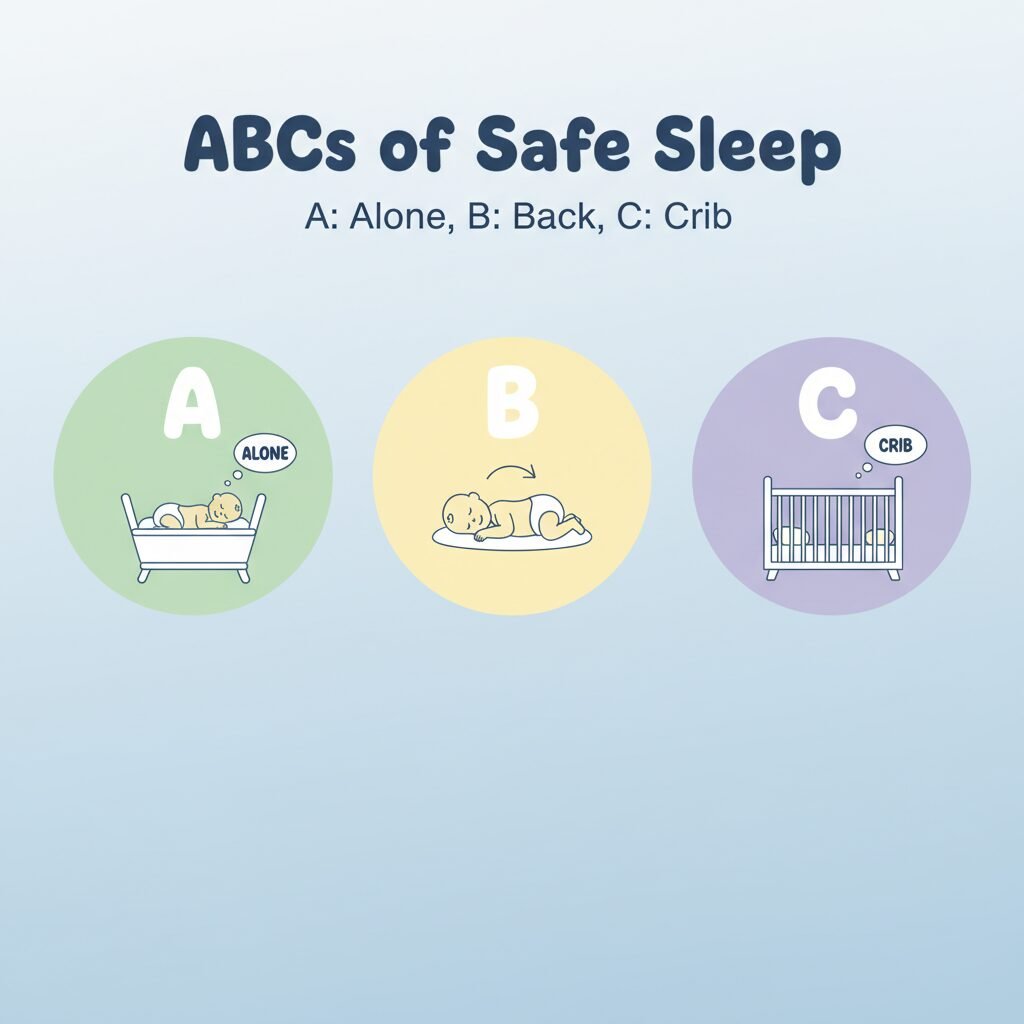
The current AAP recommendation is that the safest place for a baby to sleep is on a separate, firm surface, such as a crib or bassinet, with no soft bedding. They strongly recommend room-sharing—keeping the baby’s sleep space in the same room as you—for at least the first six months, as this practice alone can decrease the risk of SIDS by as much as 50%. However, they advise against sharing the same sleep surface.
What are the risks they’re concerned about?
- Suffocation: An adult bed is not designed for an infant. Soft mattresses, pillows, heavy blankets, or even a parent’s arm can block a baby’s tiny airway.
- Entrapment: Babies can get trapped in spaces where their head can get stuck, such as between the mattress and the wall, the headboard, or the bed frame.
- Overlying: This is a devastating and rare event where a parent rolls onto the baby during sleep.
- Overheating: Heavy adult bedding can cause a baby to overheat, which is a known risk factor for SIDS.
Please hear this with the warmth it’s intended: This information isn’t meant to scare you. It’s meant to empower you. Understanding the potential dangers is the very first step in creating a safer environment, whether you choose to bed-share or not.
Many experts acknowledge that parents fall asleep with their babies, whether they plan to or not. Therefore, the conversation is shifting from ‘never do it’ to ‘if you might do it, you absolutely must make it safer.’ The following sections are dedicated to just that.
The ‘Safe Sleep Seven’: Your Non-Negotiable Checklist for Bed-Sharing

If you are considering bed-sharing, these are not suggestions—they are essential requirements. This checklist, often called the ‘Safe Sleep Seven,’ is a set of conditions that research has shown to reduce the risks associated with bed-sharing. All seven of these conditions must be met, every single time.
- A Non-Smoking Parent: This applies to both parents and the entire household. If the mother smoked during pregnancy or if either parent is a current smoker, the risk of SIDS while bed-sharing increases dramatically. This is non-negotiable.
- Sober and Unimpaired Parents: The parent(s) in the bed must be sober. This means no alcohol, no illicit drugs, and no prescription or over-the-counter medications that cause drowsiness or deeper sleep. You need to be easily arousable to be aware of your baby’s presence.
- A Breastfeeding Baby: Research consistently shows that breastfeeding mothers and babies who bed-share have a unique connection. They are more in sync, with mothers naturally positioning themselves to protect the baby. Breastfed babies also arouse more easily from sleep, which is a protective factor against SIDS. For this reason, experts recommend bed-sharing only for breastfeeding dyads.
- A Healthy, Full-Term Baby: Bed-sharing is not for babies who were born prematurely or with a low birth weight. These infants have a higher risk of SIDS and may have more difficulty rousing themselves if their airway is compromised.
- Baby on Their Back: Just like in a crib, your baby must always be placed on their back to sleep. This is the single most effective action to reduce SIDS risk. Once they can roll confidently on their own, you don’t have to reposition them, but their initial placement must be on their back.
- A Lightly Dressed Baby (No Swaddle): Do not overdress your baby. Your body heat adds warmth. A simple sleeper is often enough. Critically, babies should never be swaddled when bed-sharing, as they need their arms free to move and signal if they are in distress.
- A Safe Surface: This is so important it gets its own section next. But in short, it means a firm, flat mattress with no pillows, blankets, or soft items near the baby.
Think of this as your pre-flight checklist. If you can’t check off every single one of these seven items, the flight isn’t safe, and you must use an alternative like a bassinet for that night.
Setting the Stage: How to Prepare Your Bed for a Tiny Guest
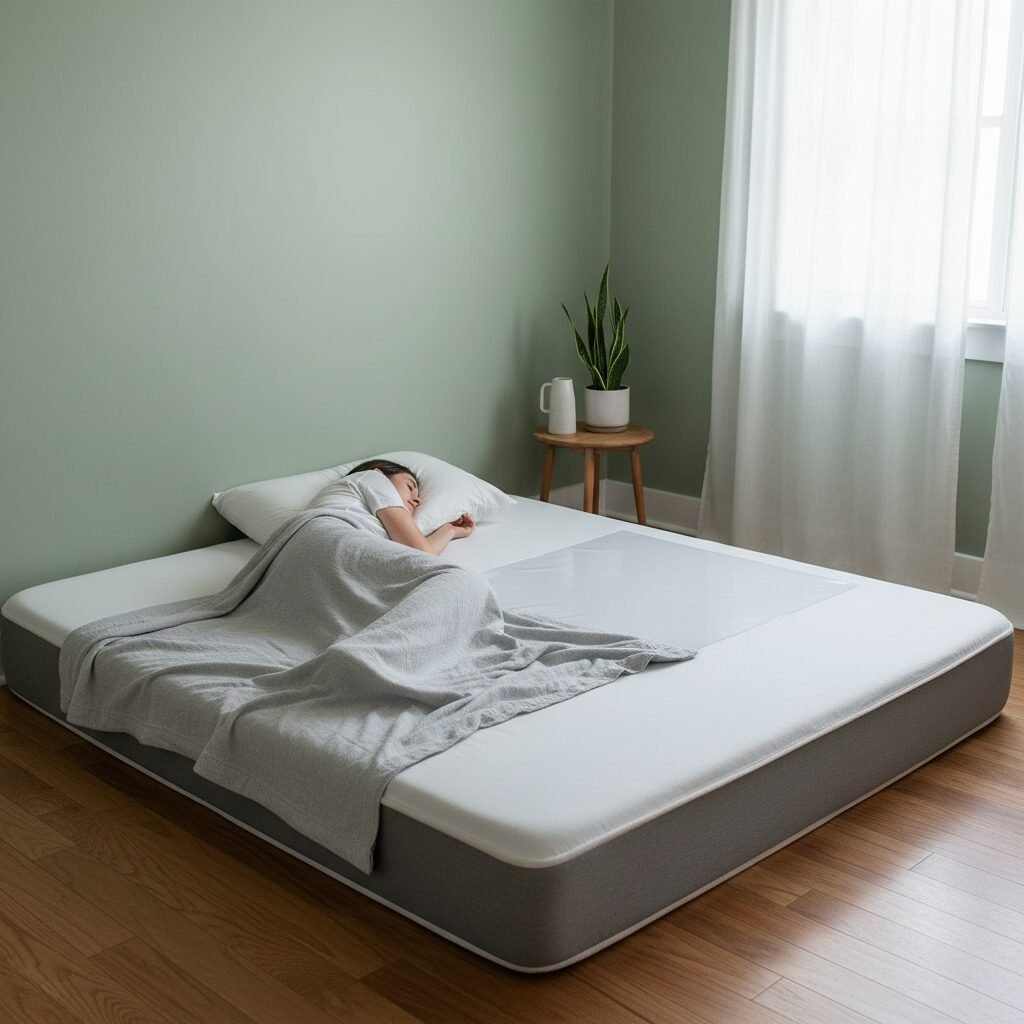
The ‘Safe Surface’ rule is the most hands-on part of preparing for bed-sharing. An adult bed is a landscape of potential hazards for a baby. Your job is to turn it into a safe, empty space. Here’s how:
Your Mattress Matters
- Firmness is Key: The mattress must be firm and flat. Memory foam, pillow-tops, waterbeds, or old, sagging mattresses are not safe. A baby’s face can sink into a soft surface, obstructing their breathing. If you press your hand on the mattress and it leaves a deep, lasting impression, it’s too soft.
- Eliminate Gaps: The mattress must fit tightly against the headboard and footboard, or even better, have neither. If you can fit a soda can in a gap, it’s a potential entrapment zone. The safest setup is often a firm mattress placed directly on the floor, away from any walls. If the bed is against a wall, it must be completely flush with no gap whatsoever.
The Bedding ‘Diet’
When it comes to bedding, less is more. Much more.
- No Pillows Near Baby: Remove all pillows from your baby’s vicinity. The mother can use one simple, flat pillow behind her head, but it should be nowhere near the baby.
- No Blankets or Duvets: Do not use heavy blankets, comforters, or duvets. Instead, dress yourself and your partner warmly in layers and use a light blanket only up to your waist, tucked securely. The baby should not be under any adult bedding. Dress the baby in a wearable blanket or appropriate sleepwear for warmth.
- Clear the Area: Remove any and all stuffed animals, decorative pillows, and bumper pads from the bed. The baby’s area should be as bare as a safe crib.
Baby’s Position on the Bed
Where the baby sleeps on the mattress is also critical. The baby should be placed on their back, next to the breastfeeding mother. Never place a baby between two adults, as the other adult may not have the same instinctual awareness of the baby. Also, never place a baby on the outer edge of the bed where they could fall off.
A Critical Safety Warning: Never, ever sleep with your baby on a couch, sofa, armchair, or recliner. These are incredibly dangerous surfaces with a very high risk of accidental suffocation and entrapment in cushions.
When Bed-Sharing is NEVER a Safe Option

While the ‘Safe Sleep Seven’ provides a framework for safer bed-sharing, there are situations where the risk is simply too high, and bed-sharing should be avoided entirely. These are absolute contraindications where no amount of preparation can make the environment safe enough.
Please do not bed-share if any of the following are true:
- A Parent is a Smoker: Even if you only smoke outside the house, particles on your clothes, breath, and hair increase your baby’s risk of SIDS. This risk is magnified in a bed-sharing situation.
- A Parent is Impaired: If you have consumed any alcohol, or taken any drugs (illicit or prescription) or medications that make you drowsy, you must place your baby in a separate sleep space. Your natural ability to arouse and be aware of your baby is compromised. This also applies if you are pathologically exhausted to the point of feeling disoriented.
- The Baby is Formula-Fed: This is not a judgment on your feeding choice. The research on this is clear: the risk of SIDS in a bed-sharing environment is higher for formula-fed infants. This is likely due to differences in arousal patterns for both baby and mother compared to breastfeeding pairs.
- You Are Not the Baby’s Parent: A babysitter, grandparent, or other caregiver should not bed-share with an infant, as they may not have the same instinctual awareness as a parent.
- Other Children or Pets are in the Bed: The bed should only be for the parents and the baby. Other children and pets can pose an overlay or suffocation risk and are not aware of the infant’s presence in the same way an adult is.
- The Baby is Premature or of Low Birth Weight: These babies are at a higher baseline risk for SIDS and should always sleep on a separate, safe surface.
If you find yourself in any of these situations, it’s a clear signal to use a safer alternative for that night’s sleep. Your baby’s safety is the number one priority.
Want the Closeness Without the Risk? Safer Co-Sleeping Alternatives
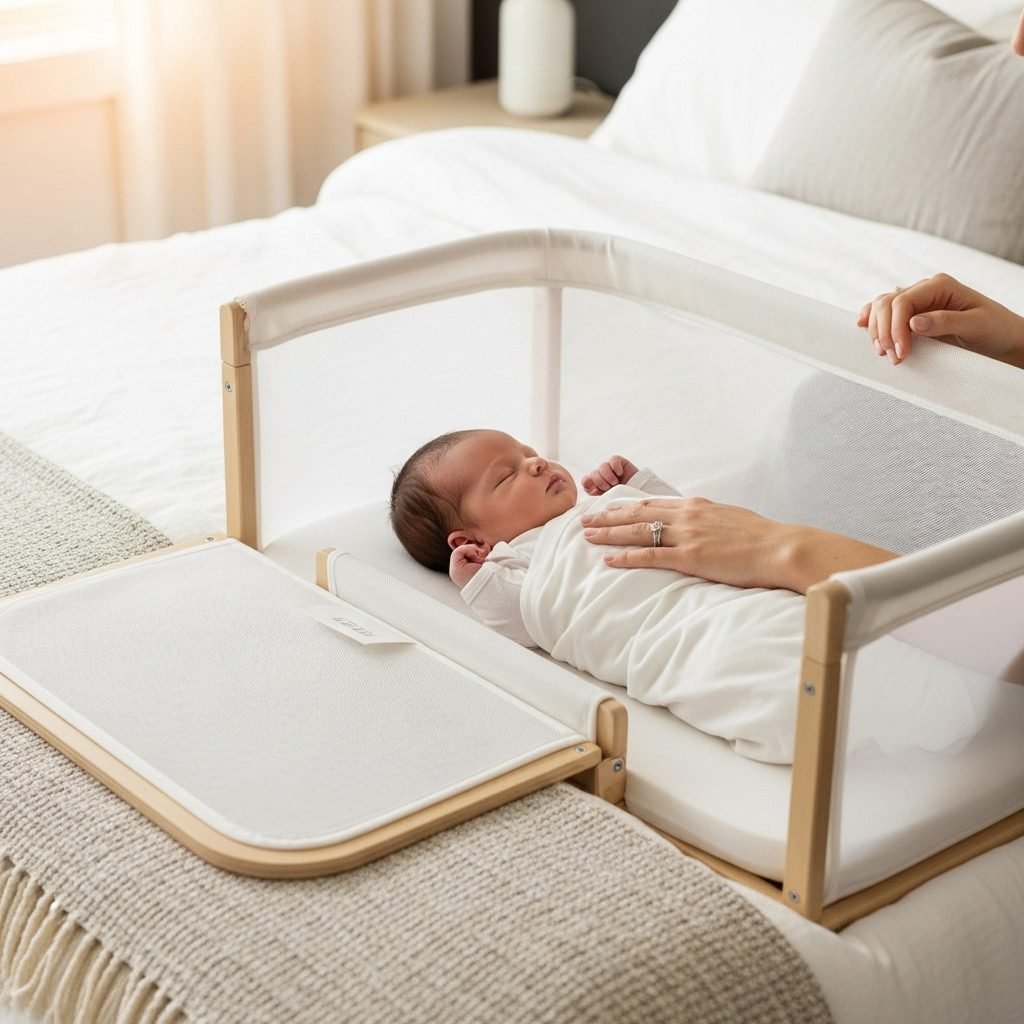
Perhaps you’ve read through the rules and feel that bed-sharing isn’t the right fit for your family, but you still crave that closeness. That’s wonderful! You have fantastic, safe options that give you the best of both worlds: proximity and peace of mind.
These methods fall under the umbrella of ‘co-sleeping’ and are recommended by the AAP to keep your baby safe while making nighttime parenting easier.
Comparing Your Safe Sleep Options
Let’s break down the most popular choices in a simple table so you can see what might work best for your family’s needs and space.
| Sleep Method | Pros | Cons | Safety Level |
|---|---|---|---|
| Room-Sharing (Separate Crib/Bassinet) | The ‘gold standard’ for safety; reduces SIDS risk by up to 50%. Baby has their own protected space. | Requires getting fully out of bed for feeding and comforting. Can take up significant room space. | Highest |
| Side-Car Co-Sleeper/Bedside Bassinet | Baby is on a separate, safe surface but within arm’s reach. Makes nighttime feeding very easy. Promotes bonding. | Can be expensive. Must be installed correctly to ensure there is no gap between the beds. | High |
| Safer Bed-Sharing (Following All Rules) | Can facilitate breastfeeding and may result in more sleep for mom. Maximum physical closeness. | Carries inherent risks even when done carefully. Requires constant vigilance and adherence to strict rules. | Safer, Not Safest |
A side-car co-sleeper or bedside bassinet is often the perfect compromise. These are small bassinets designed to attach securely to the side of your bed, or stand alone right next to it. One side often lowers, giving you easy access to your baby for feeding and soothing without having to get out of bed. Your baby gets their own flat, firm, and separate space, while you get to have them right there next to you. It’s a beautiful way to foster connection while adhering to the highest safety standards.
Conclusion
My dear, tired parent, navigating the world of newborn sleep can feel like one of the most challenging parts of this new journey. The debate around bed-sharing is filled with strong opinions, but at the end of the day, there is only one thing that matters: that your precious baby sleeps safely, and that you get the rest you need to care for them. The decision you make for your family is a personal one. Whether you choose to follow the strict guidelines for safer bed-sharing, opt for a bedside co-sleeper, or place a crib in your room, the goal is the same. Be informed, be consistent, and never compromise on safety. Trust your parental instincts, but always back them up with the facts. You are doing an amazing job. Sweet, safe dreams to you and your little one.