
White Pearls on Baby’s Gums? Why Epstein Pearls Are Not Teeth
You’re gazing at your perfect newborn, memorizing every tiny feature, when you spot them: little white bumps along their gums. For a split second, you might think, ‘Teeth? Already?!’ It’s a common moment of surprise and maybe a little bit of worry for many new parents. Take a deep, calming breath. What you’re likely seeing are not early-bird teeth, but something called Epstein pearls.
As a pediatric nurse and lactation consultant, this is one of the most frequent questions I get from new parents during those first few weeks. It’s completely understandable to be curious or concerned about anything new you find on your baby. The great news is that these little ‘pearls’ are incredibly common, completely harmless, and will disappear all on their own. In this guide, we’ll walk through exactly what Epstein pearls are, how to confidently tell them apart from other things like natal teeth or thrush, and what you can expect as they fade away. Let’s solve this little mystery together!
What Exactly Are These Little White ‘Pearls’? A Closer Look at Epstein Pearls
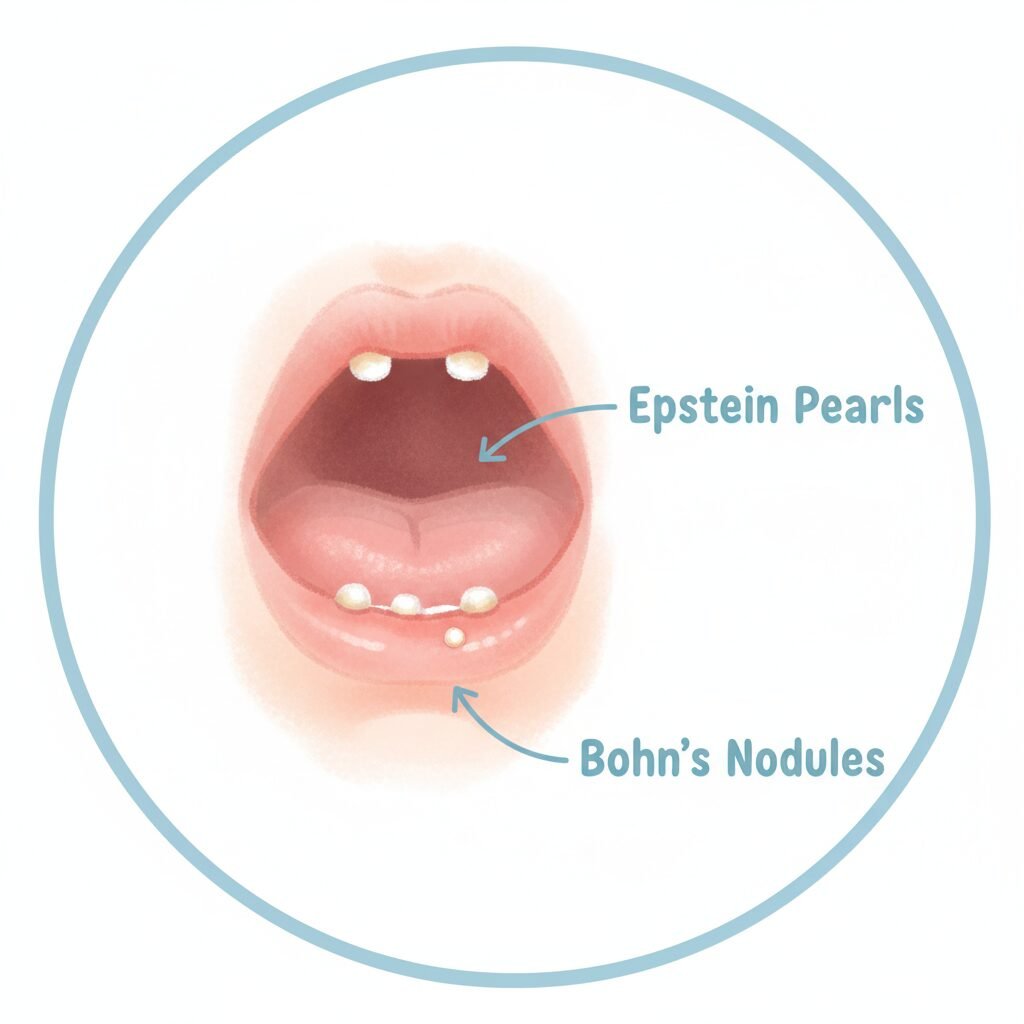
So, what’s the story behind these pearly white spots? Epstein pearls are simply tiny, harmless cysts filled with keratin. If you remember high school biology, keratin is just a type of protein that makes up our hair, skin, and nails. They are not an infection, not a sign of any underlying issue, and most importantly, they don’t cause your baby any pain.
Think of them as a tiny, temporary souvenir from their time in the womb. As your baby’s mouth and palate were forming, some skin cells (epithelial tissue) occasionally got trapped. These trapped cells formed little cystic nodules, and voilà—Epstein pearls! They are a normal part of newborn development.
Key Characteristics of Epstein Pearls:
- Appearance: They look like tiny, firm, white or yellowish-white bumps, about 1 to 3 millimeters in size. They truly resemble little pearls, which is how they got their name.
- Location: They most often appear along the midline of the roof of the mouth (the hard palate) or along the gum lines where teeth will eventually emerge.
- Frequency: They are incredibly common! Studies show that anywhere from 60% to 85% of newborns are born with them. They are more of a rule than an exception.
You might also hear the term ‘Bohn’s nodules.’ These are essentially the same type of harmless cysts, but they typically appear on the sides of the gums, away from the midline. For parents, the distinction isn’t important—both Epstein pearls and Bohn’s nodules are benign and resolve on their own without any intervention.
Is It an Epstein Pearl, a Tooth, or Something Else? A Parent’s Guide
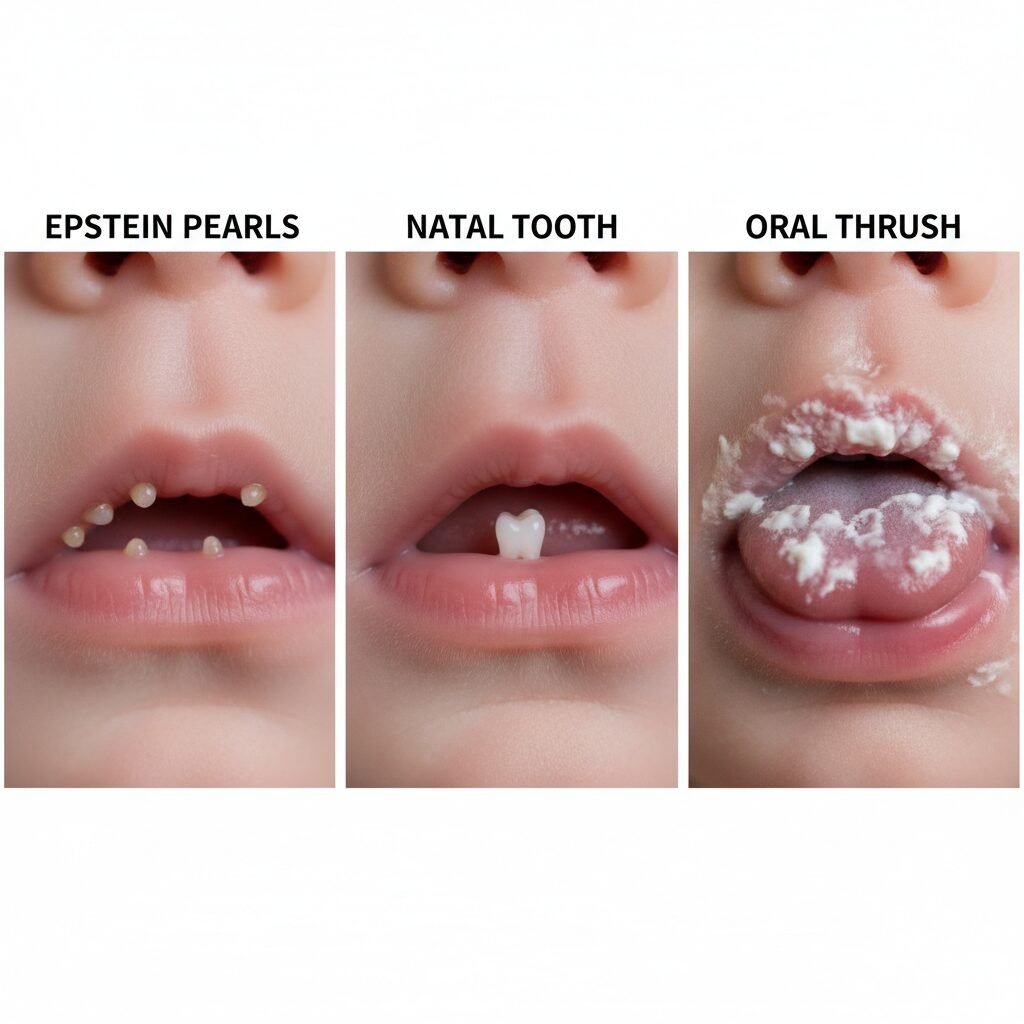
This is the million-dollar question for many parents. When you see a white spot in your baby’s mouth, your brain has a few different options to consider. Let’s break down the key differences between the three most common culprits: Epstein pearls, natal teeth, and oral thrush. This handy chart will help you become a pro at telling them apart.
| Feature | Epstein Pearls / Bohn’s Nodules | Natal Teeth | Oral Thrush |
|---|---|---|---|
| What It Is | Tiny, harmless cysts filled with keratin, trapped during development. | Actual teeth that a baby is born with. This is quite rare, occurring in about 1 in 2,000 births. | A common yeast (fungal) infection caused by Candida albicans. |
| Appearance | Small (1-3mm), round, firm, pearly white or yellowish bumps. | Looks like a small, underdeveloped tooth. Can vary in size and shape. | Creamy white, slightly raised patches that look like cottage cheese or dried milk. |
| Location | Typically on the roof of the mouth (palate) or along the gum ridges. | Most commonly found on the lower gum line, where the central incisors will be. | Can be anywhere inside the mouth: tongue, gums, roof of mouth, inner cheeks. |
| Feel & Texture | Smooth and firm. They do not move or come off when touched. | Hard and solid, like a tooth. It might be slightly loose. | The patches can often be wiped away, revealing a raw, red, and sometimes bleeding area underneath. |
| Baby’s Reaction | None. Baby is completely unbothered by them. They are not painful. | Can cause irritation to the baby’s tongue or to the mother during breastfeeding. Baby may be fussy. | Can cause discomfort and pain, leading to fussiness, feeding refusal, or clicking sounds while nursing. |
| What to Do | Nothing at all! They will resolve on their own. | Consult your pediatrician and a pediatric dentist. Sometimes they need to be removed if they are loose (a choking hazard) or causing feeding problems. | Requires a visit to the pediatrician for a prescription antifungal medication for both baby and, if breastfeeding, for mom. |
By looking at the location, appearance, and your baby’s behavior, you can usually get a very good idea of what you’re seeing. Epstein pearls are painless and stationary, while thrush can be wiped away and natal teeth look and feel like, well, teeth!
Do I Need to Do Anything? The (Very Short) Life of an Epstein Pearl

Here’s the simplest and best advice you’ll get all day: for Epstein pearls, you don’t have to do a single thing. No creams, no special cleaning, no medical procedures. The best course of action is patient observation.
These little pearls have a very short lifespan. Over the course of a few weeks to, at most, a few months, they will naturally dissolve. The gentle friction created in your baby’s mouth from everyday activities is all that’s needed to help them break down. This includes:
- Breastfeeding
- Bottle-feeding
- Sucking on a pacifier
- Their own tongue movements
The thin wall of the cyst will eventually rupture, releasing the tiny amount of keratin inside, and the spot will simply vanish without a trace. Your baby won’t even notice it happened.
A Gentle But Important Warning: It might be tempting to try and ‘help’ the process along, but please resist the urge. Never try to pop, squeeze, scrape, or rub off Epstein pearls. Your baby’s mouth is incredibly delicate and sensitive. Trying to interfere can cause pain, introduce harmful bacteria, and lead to an infection. It’s crucial to let nature take its course.
So, relax and enjoy the snuggles. This is one of those rare parenting moments where the solution is to do absolutely nothing!
When to Call the Doctor: Your Peace-of-Mind Checklist

Even when you know something is likely harmless, a little reassurance from a professional can go a long way. Trust your parental instincts! It is never wrong to call your pediatrician or family doctor if you are concerned about your baby’s health. They are there to support you and would much rather you call than worry at home.
While Epstein pearls themselves don’t require a doctor’s visit, you should definitely pick up the phone if you notice any of the following signs, as they could point to something else that does need attention:
Your Peace-of-Mind Checklist:
- Changes in Appearance: The spots seem to be growing larger, increasing in number, or changing from white to red.
- Signs of Inflammation: You notice any redness, swelling, or bleeding around the bumps.
- Your Baby Seems Uncomfortable: If your little one is unusually fussy, crying during feedings, refusing the breast or bottle, or seems to be in pain, it’s a clear sign to get them checked out.
- You Suspect Thrush: If the spots look more like milky patches and you can gently wipe them off (revealing a red area), it’s likely oral thrush and needs treatment.
- You Suspect a Natal Tooth: If the bump feels hard, has a sharper edge, and is on the lower gum line, your doctor can confirm if it’s a tooth and advise on the next steps with a pediatric dentist.
- You’re Just Not Sure: If you’ve read this guide and are still on the fence, that’s what your healthcare provider is for! A quick check-up can confirm the diagnosis and give you complete peace of mind.
Remember, you are your baby’s best advocate. Partnering with your pediatrician is a key part of navigating the journey of new parenthood.
Conclusion
Navigating the world of newborn quirks and curiosities can feel like a full-time detective job. Seeing those little white pearls on your baby’s gums is just one of many small mysteries you’ll solve along the way. The key takeaway is one of reassurance: Epstein pearls are a common, temporary, and completely harmless sign of your baby’s normal development.
They aren’t a sign of early teething, they aren’t an infection like thrush, and they require absolutely no intervention from you. All they ask for is a little bit of time and patience, and they’ll be gone before you know it. By being observant enough to notice them, you’re already proving what an attentive and caring parent you are. So, file this new piece of knowledge away, give yourself a pat on the back, and get back to the most important job—soaking in every precious moment with your new baby.