

Is Banking Cord Blood A Scam? What Every Parent Needs To Know
Hey there, amazing parents-to-be. As you get closer to meeting your little one, your mind is probably swimming with a million decisions, from car seats to feeding choices. And then, another one gets thrown into the mix, often with glossy brochures and urgent-sounding marketing: cord blood banking. You hear phrases like ‘biological insurance’ and ‘once-in-a-lifetime opportunity,’ and it’s easy to feel a wave of anxiety. Are you a bad parent if you don’t do it? Or is banking cord blood a scam designed to prey on the fears of new parents?
Take a deep breath. As a pediatric nurse and lactation consultant, I’ve sat with countless families grappling with this exact question. My goal here is to be that calm, experienced friend who helps you tune out the noise. We’re going to break down what cord blood actually is, look at the real science, compare your options without bias, and talk honestly about the costs and probabilities. Let’s get you the clear, evidence-based information you need to make the best choice for your family, free from fear and full of confidence.
What Exactly Is Cord Blood and Why Is It So Valuable?

Before we can decide whether to bank it, let’s talk about what cord blood even is. It’s not as complicated as it sounds, I promise!
After your baby is born and the umbilical cord is clamped and cut, the blood that remains in the cord and placenta is called cord blood. For a long time, this was just considered medical waste. But we now know it’s a liquid goldmine. Why? Because it’s packed with something amazing called hematopoietic stem cells (HSCs).
The Magic of Stem Cells
Think of stem cells as ‘master cells.’ They are undifferentiated, meaning they haven’t decided what they want to be when they grow up. They have the incredible ability to develop into many different types of cells in our bodies. The HSCs in cord blood are particularly good at becoming various types of blood and immune system cells.
This is what makes them so valuable for medical treatments. They can be used in transplants to rebuild a patient’s blood and immune system after it’s been damaged by diseases like:
- Leukemias and lymphomas (cancers of the blood)
- Sickle cell anemia and thalassemia (inherited blood disorders)
- Aplastic anemia (bone marrow failure)
- Certain severe immune system disorders
Essentially, a transplant of these powerful stem cells can be a life-saving treatment for over 80 different diseases. It’s a truly remarkable part of modern medicine, and it all comes from something that was once simply discarded.
A Quick Note on Collection: Collecting cord blood is completely safe and painless for both mom and baby. It happens after the baby is born and the cord has been cut, so it doesn’t interfere with the birth process or those precious first moments with your newborn.
The Two Paths: Private Banking vs. Public Donation

Okay, so we know cord blood is valuable. Now comes the main decision: what do you do with it? You have two very different options, and this is where most of the confusion comes from. Let’s compare them side-by-side.
Private Cord Blood Banking
This is what you see advertised. You pay a private, for-profit company to collect, process, and cryogenically store your baby’s cord blood exclusively for your family’s potential future use. It’s like a private savings account of stem cells.
Public Cord Blood Donation
This is an altruistic choice. You donate your baby’s cord blood to a public bank, much like donating blood. It’s listed on a national and international registry, available to any matching patient in the world who needs a transplant. This option is free of charge.
Here’s a breakdown to make it crystal clear:
| Feature | Private Banking (For-Profit) | Public Donation (Non-Profit) |
|---|---|---|
| Who Can Use It? | Exclusively your child or a compatible family member (like a sibling). | Any matching patient anywhere in the world. |
| Cost | An initial processing fee ($1,500 – $2,500+) plus an annual storage fee ($150 – $300+). | Absolutely free. The bank covers all costs. |
| Primary Purpose | Acts as a ‘biological insurance policy’ for your family. | An altruistic donation to help save the life of a stranger. |
| Collection Process | The private bank sends you a collection kit that you bring to the hospital. | You register with a public bank beforehand, and they coordinate with the hospital (only available at participating hospitals). |
| Guaranteed Storage | Yes, as long as you pay the fees, your unit is stored for you. | No. Donated units must meet strict criteria for size and quality to be banked. If it doesn’t meet the standards, it’s typically used for medical research. |
| Accessibility | You have sole control over the unit. | Once donated, you give up rights to the unit. It is not reserved for your family. |
Understanding this difference is the single most important step in making your decision. One is a financial investment in your family’s potential future, and the other is a free, charitable gift to society.
The Big Question: What Are the Odds You’ll Actually Use It?
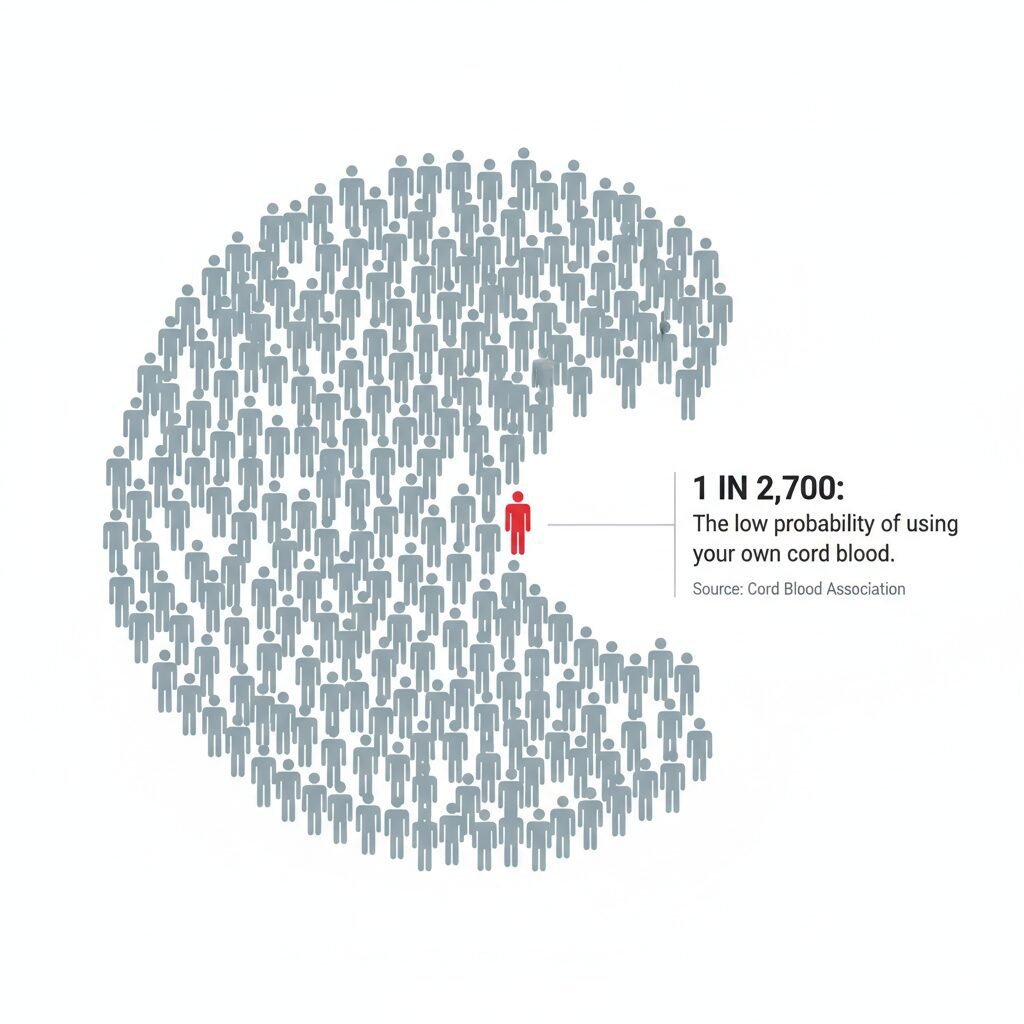
This is the heart of the ‘scam’ debate. The marketing for private banking can make it feel like a necessity, but we need to look at the numbers with a clear head. What is the real probability that your child or family will need to use their own privately banked cord blood?
The American Academy of Pediatrics (AAP) and the American College of Obstetricians and Gynecologists (ACOG) have studied this extensively. Their findings are quite surprising to many parents.
The current estimate for the lifetime probability of a person needing their own stem cells (an ‘autologous’ transplant) is somewhere between 1 in 2,700 and 1 in 20,000. It is incredibly rare.
Why So Low? Let’s Break It Down.
- Most Treatable Diseases are Genetic: For many childhood cancers like leukemia, doctors prefer to use stem cells from a healthy donor rather than the child’s own. This is because the child’s own cord blood might contain the same genetic mutations or pre-cancerous cells that led to the disease in the first place. Using a donor’s healthy cells helps to avoid reintroducing the disease.
- Sibling Use is More Common, But Still Rare: The odds are slightly better that the cord blood could be used for a sibling with a compatible tissue type. If you have a child who is already sick with a disease treatable by a stem cell transplant, then directed private banking is strongly recommended by doctors. But for a healthy family, the odds are still very low.
- The Rise of Regenerative Medicine: Proponents of private banking often point to the future of medicine, suggesting cord blood stem cells could one day be used to treat conditions like cerebral palsy, autism, or diabetes. This is an exciting field of research, but it’s important to know that these treatments are still largely experimental and not yet standard medical practice. Banking on a ‘what if’ decades down the line is a very personal gamble.
Expert Opinion: The American Academy of Pediatrics states, “Given the limited number of conditions for which autologous cord blood is a proven therapy and the low incidence of these conditions, private storage of cord blood as ‘biological insurance’ is unwise… The AAP recommends that cord blood be donated to a public bank…”
So, is it a scam? No, not in the sense that they are selling you a fake product. The science is real. But the marketing often overstates the likelihood of you needing the product, which can feel misleading and exploitative to worried parents.
The Cost Breakdown: Is Private Banking a Worthwhile Investment?

Since public donation is free, this section is all about the costs of private banking. If you’re considering it as an insurance policy, it’s crucial to understand the long-term financial commitment.
The costs can be broken down into two main parts:
- Initial Fee: This one-time fee covers the collection kit, courier service to transport the blood to the lab, and the initial processing and testing of the unit. This typically ranges from $1,500 to $2,500. Some companies offer payment plans.
- Annual Storage Fee: After the first year, you’ll pay a yearly fee to keep the unit cryogenically frozen. This usually costs between $150 and $300 per year.
Let’s do some quick math. If you store the cord blood for 20 years, you could be looking at a total investment of:
$2,000 (initial fee) + ($200/year x 20 years) = $6,000
And that’s just for one child. If you have multiple children, the cost multiplies. This is a significant expense that could otherwise go toward other essential family needs, like a college savings fund, retirement, or even just diapers!
Is It Worth It For Your Family?
This is a deeply personal question with no single right answer. You have to weigh the high cost and low probability of use against your own peace of mind.
- Consider your family’s medical history. Is there a strong prevalence of specific blood cancers or genetic disorders that could potentially be treated with a stem cell transplant? While not a guarantee, this might shift the balance for some families.
- Talk to your doctor or a genetic counselor. Get a professional, unbiased opinion based on your specific health history.
- Evaluate your financial situation. Can you comfortably afford this expense without sacrificing other important financial goals for your family?
Viewing it as a luxury ‘peace of mind’ purchase, rather than a medical necessity, can help frame the decision more realistically.
Making Your Decision: A Final Checklist for Parents

You’ve learned what cord blood is, the difference between private and public options, the statistics, and the costs. Now it’s time to bring it all together. Here’s a simple step-by-step thought process to guide your final decision.
Step 1: Assess Your Family’s Immediate Medical Need
Do you currently have a child or close family member with a disease that is treatable with a stem cell transplant?
- If YES: Talk to your doctor immediately about directed donation or private banking. In this specific scenario, it is often highly recommended.
- If NO: Proceed to the next step.
Step 2: Consider Public Donation First
Is your delivering hospital a partner with a public cord blood bank? (You can check the Be The Match registry online).
- If YES: This is a fantastic, free, and altruistic option that is strongly encouraged by the entire medical community. It has the potential to save someone’s life. For most families, this is the most impactful choice.
- If NO: Your options are private banking or simply doing nothing and allowing the cord blood to be discarded as medical waste.
Step 3: Evaluate Private Banking as a Financial Decision
If public donation isn’t an option or you’re still considering private banking, ask yourself these questions:
- Have we reviewed our family’s full medical history?
- Have we discussed the low probability of use for our own child?
- Are we comfortable with the long-term cost of thousands of dollars over two decades?
- Does spending this money give us genuine peace of mind, or is it causing financial stress?
- Are we banking based on evidence, or based on fear created by marketing?
Answering these questions honestly will lead you to the right conclusion for you. There is no judgment here. Some families have the financial resources and decide the tiny chance is worth the cost for their peace of mind, and that’s perfectly okay. Other families decide their money is better spent elsewhere, and that is also perfectly okay.
Conclusion
So, is banking cord blood a scam? The final verdict is: no, it’s not a scam, but the marketing can be deeply misleading. The science is real, and private banks do provide the service they sell. However, the sales tactics often prey on the emotions of expectant parents by overstating the benefits and urgency for the average family.
For the vast majority of families with no history of specific diseases, the most medically and socially beneficial choice is public donation. It costs you nothing and could be the miracle another family is desperately praying for. If that’s not an option, or if you have the financial means and desire the ‘what if’ insurance of private banking, that is a valid personal choice.
The most important thing is that you are making this decision from a place of knowledge, not fear. You are already an incredible parent because you are taking the time to research and thoughtfully consider what’s best for your growing family. Trust your research, trust your gut, and be confident in the path you choose. You’ve got this.