
Why ‘Parentese’ Makes Your Baby Smarter (And ‘Goo-Goo-Ga-Ga’ Doesn’t)
If you’ve ever found yourself cooing at a baby in a high-pitched, sing-songy voice, you might have felt a little silly. It’s an almost universal instinct, that shift in our speech when we see a tiny, adorable face. For years, we’ve lumped it all under the umbrella of ‘baby talk.’ But what if I told you there’s a world of difference between mindless ‘goo-goo-ga-ga’ and a specific, scientifically-backed way of communicating that can actually make your baby smarter? Welcome to the wonderful world of ‘Parentese’.
As a pediatric nurse and lactation consultant, I’ve spent decades helping new parents navigate the beautiful, chaotic, and often confusing journey of newborn care. One of the most common questions I get is about development: ‘Am I doing enough?’ ‘Is my baby on track?’ The amazing news is that one of the most powerful tools for boosting your baby’s brain development is something you can do anytime, anywhere, and it costs absolutely nothing. It’s all in how you talk to them. In this guide, we’ll unpack the magic of Parentese, explore the fascinating science behind why it works, and give you simple, practical ways to become a Parentese pro, strengthening your bond while building your baby’s future vocabulary.
What Exactly is Parentese? (Hint: It’s Not Just Silly Noises)
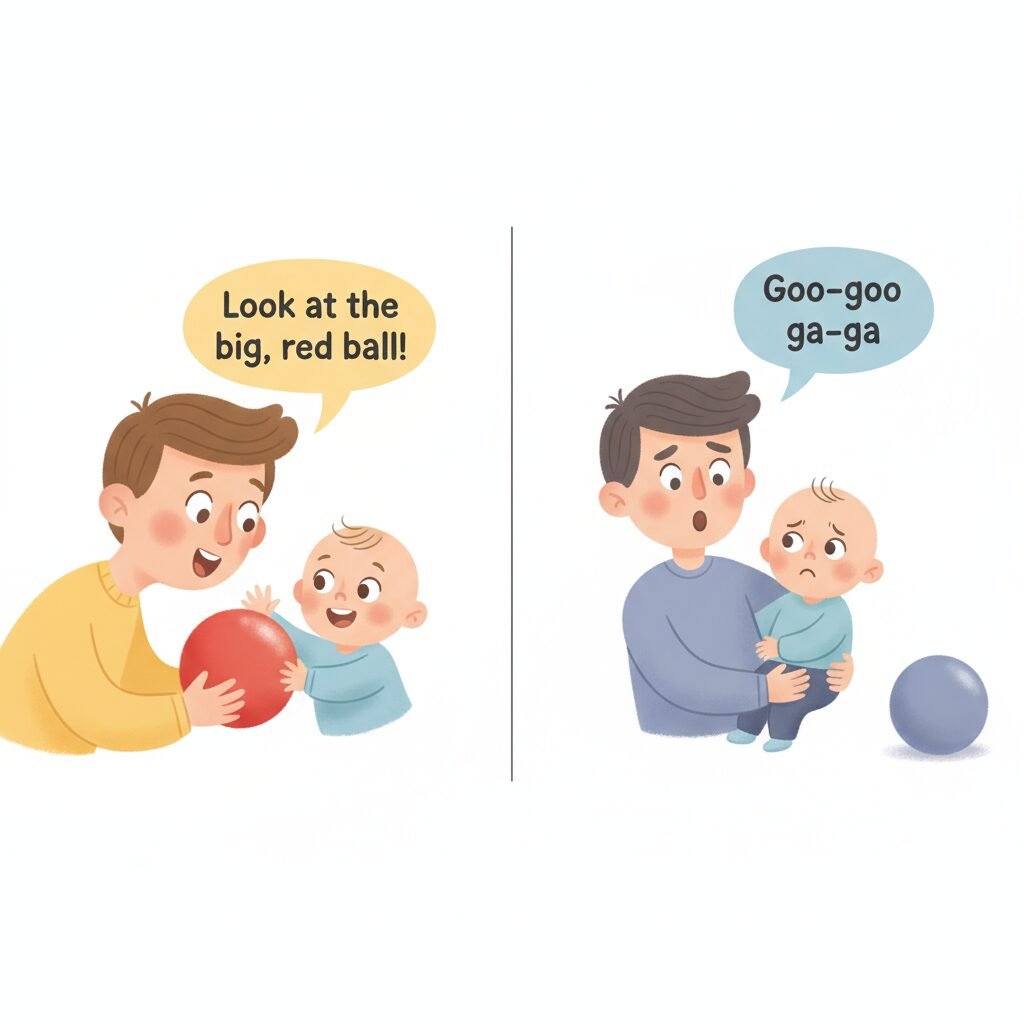
First things first, let’s clear up a common misconception: Parentese is not the same as the nonsensical ‘baby talk’ you might be thinking of. While both involve a certain ‘baby voice,’ Parentese is structured, linguistic, and purposeful. It’s a specific speech style that adults across cultures naturally adopt when speaking to infants. It’s less about what you say and more about how you say it.
Think of it as a special dialect designed for the tiniest of listeners. Their brains are wired to tune into it! While traditional baby talk often uses made-up words and jumbled sounds, Parentese uses real words and correct grammar, just delivered in a baby-friendly package.
The Key Ingredients of Parentese:
- Higher Pitch: Our voices naturally go up a few notches. Babies are more attentive to higher-frequency sounds.
- Sing-Songy Melody: The tone rises and falls in an exaggerated, melodic way. This is often called ‘prosody,’ and it captures and holds a baby’s attention far better than a monotone adult voice.
- Slower Tempo: We slow down our speech, with longer pauses between phrases. This gives your baby’s developing brain time to process the sounds and track the words.
- Simple Words and Short Sentences: We use real, simple vocabulary and grammatically correct but short sentences. For example, instead of ‘The sphere is crimson,’ you’d say, ‘Look at the red ball!’
- Lots of Repetition: Repeating words and phrases is key. ‘Where are your toes? Yes! These are your little toes!’ This repetition helps solidify new words in their memory.
- Exaggerated Facial Expressions: Parentese is a full-body experience! Wide eyes, raised eyebrows, and big smiles help convey meaning and emotion, giving your baby extra social and emotional cues.
To make it crystal clear, let’s look at a side-by-side comparison:
| Parentese (Brain-Building!) | Traditional ‘Baby Talk’ (Less Effective) |
|---|---|
| ‘Heeeello, my sweet baby! Are you looking at the blue block? What a big block!’ | ‘Goo-goo ga-ga. Who’s a little wubby? Izzy woozy cootchie-coo.’ |
| Uses real words, simple grammar, and describes the environment. | Uses made-up, nonsensical words with no grammatical structure. |
| Engages the language centers of the baby’s brain and teaches vocabulary. | May get a baby’s attention but doesn’t provide linguistic information. |
A Quick Tip: Don’t feel pressured to ‘perform.’ The most effective Parentese is natural and comes from a place of love. Just focus on connecting with your baby, and the sing-songy voice will likely follow!
The Brain-Building Science Behind the ‘Baby Voice’

So, why does this seemingly simple change in your voice have such a profound impact? It’s not just about being cute; it’s about neurobiology. Your baby’s brain is undergoing the most rapid period of development it will ever experience, forming more than a million new neural connections every single second. The input they receive from their environment literally shapes the architecture of their brain, and your voice is the most important sound in their world.
Capturing Attention and Boosting Engagement
Studies using brain-mapping technology have shown that Parentese lights up the auditory and social centers of a baby’s brain like a fireworks display. Researchers at the University of Washington’s Institute for Learning & Brain Sciences (I-LABS) found that the exaggerated melodies and slower tempo of Parentese are perfectly tuned to a baby’s auditory preferences. A regular adult voice can get lost in the background noise, but the unique acoustic properties of Parentese cut through the clutter and signal to your baby: ‘Hey! This is for you! Listen up!’
Making Language Learnable
Imagine trying to learn a new language by listening to someone speak at lightning speed with no pauses. It would be impossible to tell where one word ends and another begins. That’s what normal adult speech sounds like to a baby. Parentese solves this problem.
- Slowing Down: The slower pace and elongated vowels (‘Looook at the caaaat’) help babies ‘segment’ the speech stream. It gives them a chance to identify individual sound units (phonemes) and eventually, whole words.
- Exaggerated Vowels: When you say ‘beeell’ instead of ‘bell,’ you are giving your baby a clearer, more distinct version of that vowel sound. This helps them build the fundamental auditory map they’ll need for a lifetime of language.
- Emotional Connection: The warm, affectionate tone of Parentese does more than just transmit words; it transmits emotion. This creates a positive, nurturing feedback loop. Your baby feels safe, loved, and connected, which primes their brain for learning. A calm, engaged brain is a learning brain.
Safety and Reassurance: Your loving voice is a source of comfort. When your baby is fussy or upset, speaking to them in the gentle, melodic rhythm of Parentese can lower their stress levels and help them feel secure. It’s a powerful tool for emotional regulation.
A landmark study found that infants whose parents were coached to use more Parentese babbled significantly more and had larger vocabularies by 18 months than infants in the control group. The takeaway is clear: the more Parentese your baby hears, the more they practice making sounds, and the faster their language skills develop.
How to Become a Parentese Pro: Simple Tips for Everyday Life

Knowing the science is one thing, but putting it into practice is what really counts. The beauty of Parentese is that you don’t need any special equipment or scheduled ‘learning time.’ You can weave it into the everyday moments you’re already sharing with your baby. This is all about turning routine care into quality connection.
Narrate Your Day
The easiest way to start is by becoming your baby’s personal sportscaster. Simply talk about what you’re doing, seeing, and feeling as you go about your day. This is often called ‘self-talk’ (narrating your own actions) and ‘parallel-talk’ (narrating your baby’s actions).
- During Diaper Changes: ‘Okay, let’s get you a clean diaper! We’ll wipe you all clean. Now let’s lift your little legs. Up, up, up! There we go! All fresh and clean!’
- During Mealtime: ‘Are you hungry? Here comes the yummy milk! You are drinking so well. Gulp, gulp, gulp. You must have been a thirsty little baby!’
- During a Walk: ‘We’re going outside! Do you see the big tree? And look, there’s a puppy! The puppy says ‘woof woof!”
- During Bath Time: ‘Time for a bath! The water is so warm. Let’s splash! Splash, splash, splash! Now we’ll wash your tiny toes.’
Read, Read, and Read Some More
Reading books aloud is a Parentese supercharger. You don’t even have to stick to the words on the page. Point to the pictures and describe them with enthusiasm. ‘Look at the yellow duck! The duck says ‘quack quack!” The rhymes and rhythms in children’s books are a natural fit for the melodic style of Parentese.
Serve and Return Conversations
Communication is a two-way street, even before your baby can talk. This is called ‘serve and return.’ When your baby ‘serves’ by cooing, babbling, or making a facial expression, ‘return’ it by responding in Parentese.
- Baby: *coos*
- You: ‘Oh, really? Is that what you think? Tell me more about it!’
- Baby: *points at the cat*
- You: ‘Yes, you see the kitty! The kitty is so soft and fluffy.’
This back-and-forth teaches your baby the fundamental rhythm of conversation and shows them that their voice matters.
Remember, it’s a marathon, not a sprint. You don’t have to talk this way 24/7. Just sprinkling these Parentese-rich interactions throughout your day will make a huge difference. Be patient with yourself and have fun with it!
From Babbling to First Words: Tracking the Impact of Parentese

So, you’re chatting away in your best Parentese voice. What can you expect to see? The results aren’t just theoretical; you’ll witness the impact in your baby’s own developmental journey. Using Parentese provides a direct pathway to hitting those exciting language milestones.
Encouraging the First ‘Conversations’
Long before their first word, your baby will start communicating through coos and babbles. When you respond to these early sounds with engaged Parentese, you’re telling them, ‘I hear you, and what you’re saying is important!’ This encourages them to ‘talk’ more. They’ll start to vary their pitch and tone, mimicking the melodic sounds they hear from you. This vocal play is critical practice for their tongue, lips, and vocal cords.
Babies who are consistently spoken to in Parentese tend to start babbling earlier and produce more complex babble (like ‘da-da-da’ or ‘ma-ma-ma’) than babies who hear less of it. This isn’t just noise; it’s the beginning of real speech.
Building a Vocabulary Powerhouse
The link between Parentese and vocabulary size is one of the most well-documented findings in child development research. The more words a baby hears in this clear, engaging format, the more words they understand and, eventually, the more words they will say. The repetition of key words in different contexts (‘Here is your blue ball. The sky is blue.’) helps your baby’s brain make the connection between the sound of the word and the object it represents.
Here’s a general guide to what you might observe. Remember, every baby is unique and develops on their own timeline!
| Age Range | Language Milestone | How Parentese Helps |
|---|---|---|
| 0-3 Months | Reacts to sounds, coos. | Your melodic voice soothes them and teaches them to associate sound with comfort and connection. |
| 4-6 Months | Begins to babble, laughs, makes gurgling sounds. | Responding to their babbles with Parentese encourages more vocal experimentation and ‘serve and return’ conversations. |
| 7-12 Months | Understands ‘no,’ responds to their name, uses more complex babble. | Using their name often and narrating your day helps them connect words with people and actions. |
| 12-18 Months | Says first words (‘mama,’ ‘dada’), points to objects you name. | The clear, slow pronunciation in Parentese makes it easier for them to imitate and form their first real words. |
A Gentle Reminder: Please don’t treat this like a checklist for comparison. This is simply a guide to help you celebrate the amazing progress your little one is making. The most important thing is the warm, responsive relationship you’re building together. The language will follow.
Conclusion
Navigating new parenthood can often feel like you need a secret decoder ring for everything. But when it comes to your baby’s early language and brain development, the secret isn’t a secret at all. It’s your own voice, tuned to the specific, loving frequency of Parentese. It’s a simple, instinctual, and incredibly powerful tool that you have at your disposal every single day.
By embracing that higher pitch, slowing down your speech, and narrating your world with love and enthusiasm, you are doing so much more than just passing the time. You are laying the neural groundwork for language, strengthening your emotional bond, and giving your baby a profound sense of security and importance. You are showing them that they are heard, seen, and cherished.
So, the next time you find yourself cooing over your baby’s tiny fingers or narrating a diaper change in a sing-songy voice, do it with confidence and joy. You’re not just being a silly parent; you’re being a brain-builder. You’re giving your child one of the greatest gifts imaginable: the foundation for a lifetime of learning, connection, and communication.