

7 Secrets To Getting Your Newborn To Sleep Without Being Held Instantly
Hello, dear new parent. Take a deep breath. I know you’re tired. There is absolutely nothing in the world more precious than the feeling of your newborn sleeping soundly on your chest. That warmth, that trust, those tiny breaths—it’s pure magic. Many of us dream of these moments, and it’s completely natural to want to soak up every second.
But I also know the other side of that coin. Your arms are numb, your back aches, you haven’t eaten a hot meal in days, and the thought of putting your baby down only to have them wake up instantly is heartbreaking. You need to shower, you need to sleep, you need a moment to just be. If you’re reading this, you’re likely wondering if it’s even possible for your little one to sleep without being attached to you. I’m here to tell you, with all the warmth and reassurance of a nurse who has supported thousands of families: it is absolutely possible.
These aren’t harsh, cry-it-out methods. These are seven gentle, loving, and effective ‘secrets’—insider tips from my decades in newborn care—that honor your baby’s need for security while gently teaching them the valuable skill of independent sleep. Let’s walk through this together, one sleepy step at a time.
Secret #1: Master the ‘Drowsy But Awake’ Transition

This is the golden rule of newborn sleep, but it’s often misunderstood. ‘Drowsy but awake’ doesn’t mean putting a wide-eyed baby into their crib and hoping for the best. It’s all about catching the perfect, fleeting window of opportunity. Think of it as your baby being on the very edge of sleep—their eyelids are heavy and fluttering, their body is limp and relaxed, and they might give a final, slow blink before drifting off. That’s the moment.
Why is this so important? When a baby falls asleep in your arms and is then transferred, they may wake up startled in a new environment. It’s like if you fell asleep in your bed and woke up on the front lawn—confusing and unsettling! By placing them down when they are drowsy, you are helping them associate their own sleep space (the bassinet or crib) with the actual act of falling asleep. This is the foundational skill for independent sleep.
How to Spot the ‘Drowsy’ Window:
- Yawning: This is the most obvious cue!
- The ‘Thousand-Yard Stare’: They might stare off into the distance, looking unfocused.
- Reduced Motion: Their frantic arm and leg movements will slow down and become more fluid.
- Eye Rubbing: A classic sign of sleepiness.
When you see these signs, begin your gentle transition. Lower your baby into the bassinet slowly and smoothly, keeping your hands on them for a moment to provide reassurance before quietly slipping away.
If they cry, it’s okay. Your job isn’t to abandon them. You can gently pick them up, soothe them back to that drowsy state, and try again. This gentle repetition is how they learn.
Secret #2: Recreate the Womb with the 5 S’s
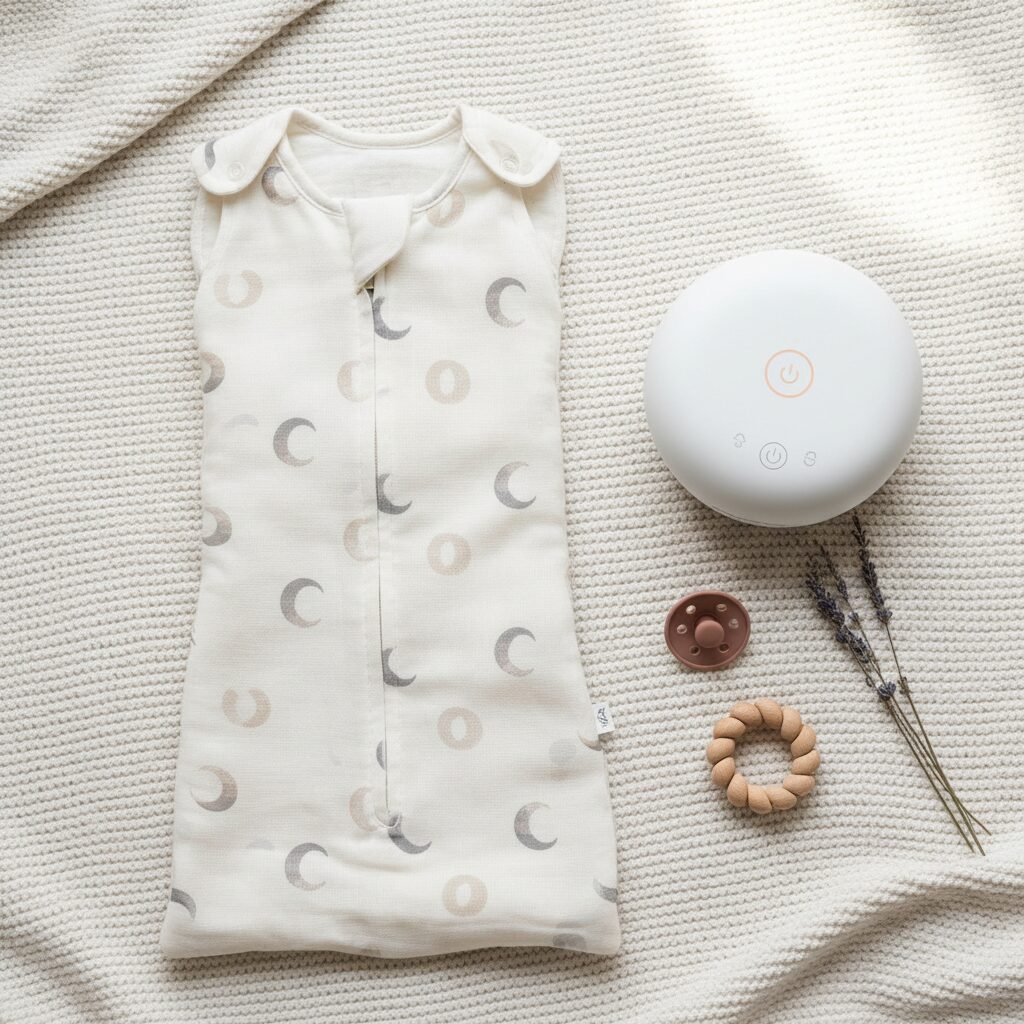
For nine months, your baby lived in a very specific environment: it was snug, constantly moving, and filled with a loud ‘whooshing’ sound. The outside world is jarringly quiet, still, and open in comparison. The ‘5 S’s,’ a concept popularized by pediatrician Dr. Harvey Karp, are a set of tools to recreate that womb-like sensory experience and trigger your baby’s calming reflex.
- Swaddling: Think of a swaddle as a wearable hug. It provides a snug, secure feeling that mimics the confines of the womb and, crucially, prevents their startle (Moro) reflex from waking them up. Use a purpose-built swaddle sack with velcro or a zipper for ease and safety.
- Side/Stomach Position (for calming only): Holding your baby on their side or tummy is incredibly effective for calming fussiness. It seems to deactivate the Moro reflex.
Safety First! This position is only for calming your baby in your arms while you are awake and supervising. The American Academy of Pediatrics is clear: for sleep, babies should always be placed on their back.
- Shushing: The womb is not silent! It’s filled with the sound of blood flow, which is actually louder than a vacuum cleaner. A strong, continuous ‘shushing’ sound, or better yet, a white noise machine, replicates this comfort. Keep it on for the entire duration of their sleep.
- Swinging: Your baby was constantly in motion before birth. Gentle, rhythmic movement like rocking, swaying, or using a baby swing (for supervised naps) can be deeply soothing. The key is small, jiggly movements rather than big, wild swings.
- Sucking: Sucking is a powerful self-soothing mechanism. Offering a pacifier after breastfeeding is established (usually around 3-4 weeks) can satisfy this innate need and help them relax into sleep without needing to be held.
Secret #3: Leverage the Comforting Power of Your Scent

A newborn’s sense of smell is one of their most powerful and developed senses. They know you. Your unique scent means safety, food, and comfort. We can use this powerful biological connection to help them feel secure even when you’re not physically holding them.
The idea is to gently infuse their sleep space with your familiar scent, tricking their primal brain into thinking you’re still nearby. It’s a simple but remarkably effective psychological comfort.
Safe Ways to Share Your Scent:
- Wear the Bassinet Sheet: Tuck the clean bassinet sheet into your shirt for a few hours before putting it on the mattress. It will absorb your scent and surround your baby with it.
- The T-Shirt Method: Sleep in a soft t-shirt for one night. Before you put the baby down, lay that t-shirt over the mattress. Once you place your baby in the bassinet, remove the t-shirt completely. The lingering scent is all you need.
Important Safety Note: To reduce the risk of SIDS, the baby’s sleep space must be completely empty. Never leave any loose items, including clothing, blankets, or cloths, in the bassinet or crib with your baby while they are sleeping.
Secret #4: The Surprising Magic of the Strategic Pause
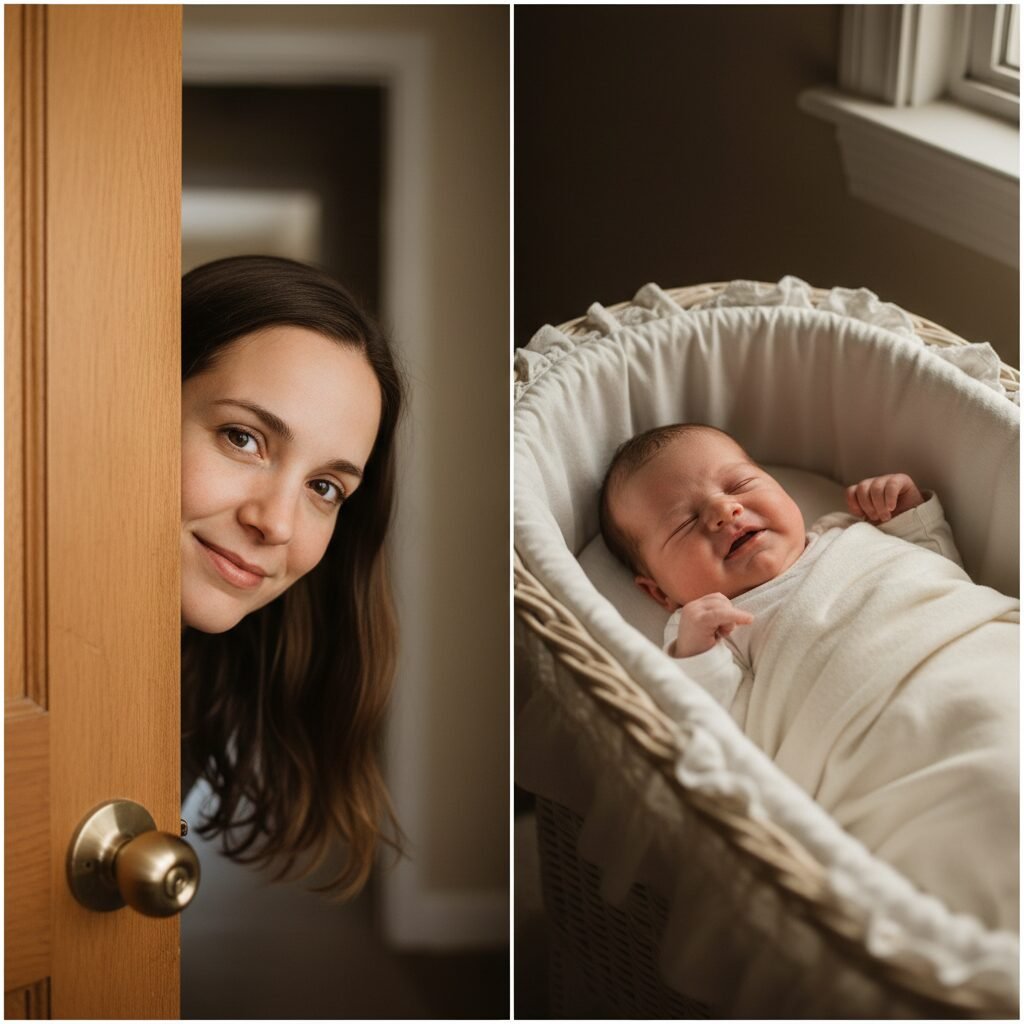
As a new parent, your nervous system is wired to respond to every single sound your baby makes. It’s a beautiful, protective instinct! However, newborns are surprisingly noisy and active sleepers. They grunt, groan, whimper, twitch, and even cry out briefly—all while being completely asleep. This is called ‘active sleep’ and it’s a normal part of their sleep cycle.
If we rush in and scoop them up at every little noise, we can inadvertently wake them up when they were perfectly capable of transitioning to their next sleep cycle on their own. The ‘Strategic Pause’ is about giving them that chance.
When you hear your baby start to fuss after you’ve put them down, just pause. Stop what you’re doing, watch them on the monitor or from the doorway, and count to 60. It can feel like the longest minute of your life! But you’ll be amazed at how often they will settle themselves back down without any help from you. You aren’t ignoring them; you are giving them the space and opportunity to develop their own self-soothing skills. You’re trusting them, and in turn, teaching them to trust themselves.
Secret #5: Break the Feed-to-Sleep Association with a Simple Rhythm
It is so natural and easy to fall into a feed-to-sleep pattern. Nursing or bottle-feeding is warm, comforting, and the sucking motion is naturally sleep-inducing. While this is perfectly fine and often necessary in the very early weeks, it can become a sleep crutch that is difficult to move away from later. If the baby only knows how to fall asleep while eating, they will demand to eat every time they wake up, whether they are hungry or not.
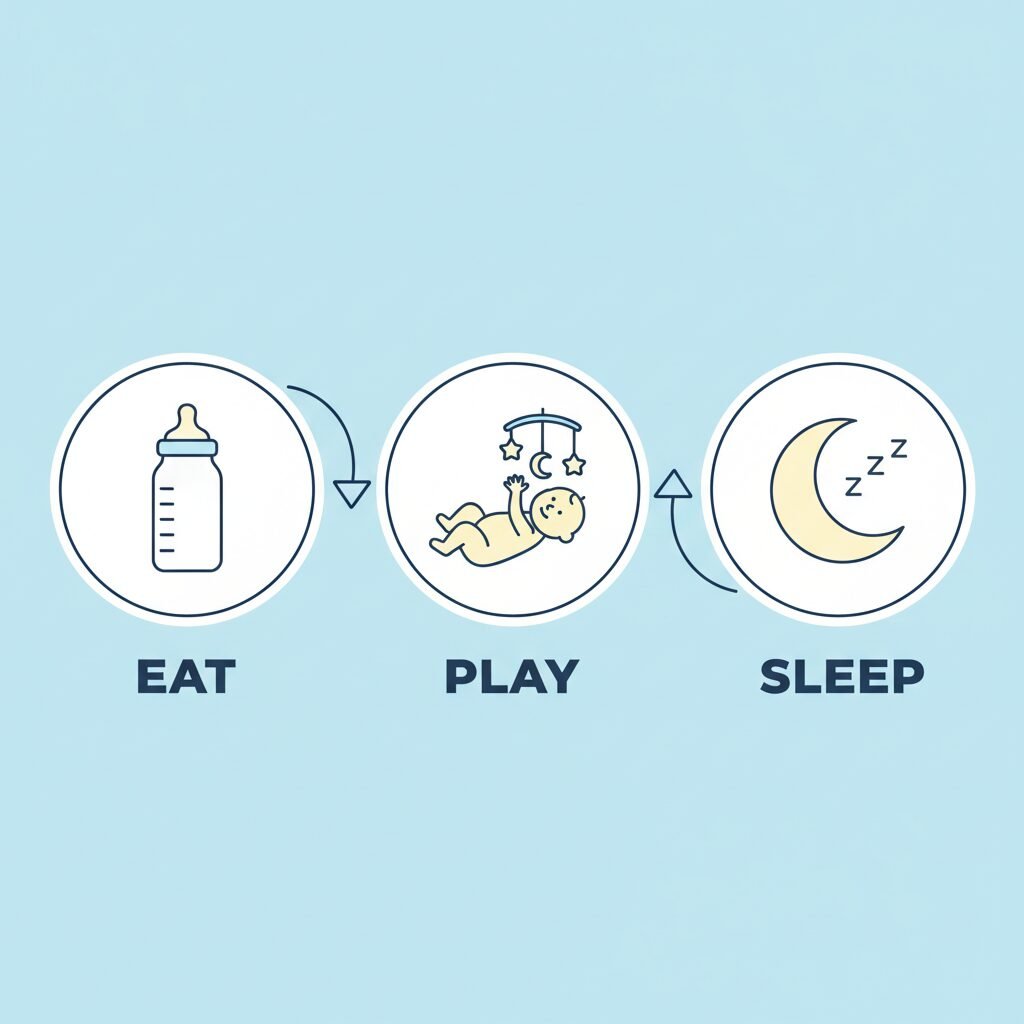
The secret is to gently uncouple feeding from sleeping by introducing a simple rhythm to your day: Eat, Play, Sleep. This predictable pattern helps your baby understand that eating is for energy and nutrition, and sleep is something that happens after a period of activity.
A Sample ‘Eat, Play, Sleep’ Cycle:
This isn’t a strict schedule, but a flexible rhythm that follows your baby’s lead.
| Activity | Description | Timing Example (for a 2-month-old) |
|---|---|---|
| Eat | Baby wakes up and has a full, effective feeding (breast or bottle). The goal is to fill their tummy. | 7:00 AM |
| Play (Awake Time) | This is their ‘activity’ period. It could be tummy time, a diaper change, looking at a mobile, listening to you sing, or simply cuddling. | 7:30 AM – 8:15 AM |
| Sleep | Watch for sleepy cues (yawning, fussiness). Swaddle them, turn on the white noise, and put them down for their nap ‘drowsy but awake’. | 8:15 AM – 9:45 AM |
By following this pattern, you ensure they are well-fed before their awake time and are going down for their nap because they are genuinely tired, not just because they’ve dozed off at the breast or bottle.
Secret #6: The Simple ‘Warm Spot’ Trick

Have you ever noticed how your baby can be completely limp and asleep on your warm, 98.6°F (37°C) body, but the second their back touches the cool, flat surface of their bassinet, their eyes fly open? That temperature change can be incredibly jarring for a tiny baby who is used to constant warmth.
The ‘Warm Spot’ trick is a wonderfully simple hack to ease this transition. The goal is to make the bassinet surface less of a shock to their system by safely pre-warming it.
How to Safely Warm the Spot:
- Take a heating pad (on the lowest setting) or a hot water bottle and place it on the bassinet sheet, right where you plan to lay your baby.
- Let it sit there for 5-10 minutes while you are finishing up your soothing routine (rocking, shushing, etc.).
- This next step is the most important part. Right before you are ready to put the baby down, you must remove the heating pad or hot water bottle from the bassinet.
- Briefly touch the sheet with the back of your hand to ensure it is pleasantly warm, but not hot.
Laying your baby down onto this cozy, warm spot feels much more familiar and less startling than a cool mattress, which can make all the difference in a successful transfer.
Secret #7: The Gentle Art of the Gradual Release

For some babies, especially those who really love their cuddles, the transition needs to be even more gradual. The ‘Gradual Release’ is a technique that provides immense physical reassurance and slowly tapers it off as they drift to sleep. It’s about building trust and security in their own sleep space.
Here’s how it works:
- Step 1: The Heavy Hand. After laying your baby down (drowsy but awake), place one hand firmly but gently on their chest and the other on their tummy or legs. The steady pressure is very calming and prevents them from feeling like they’ve been ‘dropped.’ Don’t pat or jiggle; just apply still, comforting pressure.
- Step 2: The One-Hand Hold. Once you feel their body relax and their breathing deepen, slowly and smoothly lift one of your hands away. Continue applying pressure with the remaining hand for another minute or two.
- Step 3: Hands Off. When they seem settled, slowly lift your final hand away. Keep it hovering just above them for a moment in case they stir.
- Step 4: The Lingering Presence. Remain by the side of the bassinet for a few more minutes, letting them hear your quiet breathing. Your presence is still a comfort. Then, you can quietly sneak away.
If at any point they startle or fuss, simply go back to the previous step. This isn’t a race. It’s a slow, patient dance that communicates, ‘I’m here, you are safe, and you can do this.’
Conclusion
My dear, tired parent, please remember to be kind to yourself. Helping your newborn learn to sleep independently is a process, not an overnight fix. There will be good days and tough days. The goal is not perfection; it’s progress. Some days, you will still need those contact naps, and you should soak them up without a shred of guilt. But on the days when you need your hands back, you now have a toolkit of seven gentle secrets to try.
You are your baby’s expert. Listen to their cues, trust your instincts, and celebrate the small victories. By providing a safe space, a predictable rhythm, and layers of comfort, you are giving your child a wonderful gift: the skill of peaceful sleep. You are doing an amazing job. Rest is coming—for both of you. Sweet dreams.